Facebook Ads for Dental Clinics: A 2026 Lead-Generation Playbook
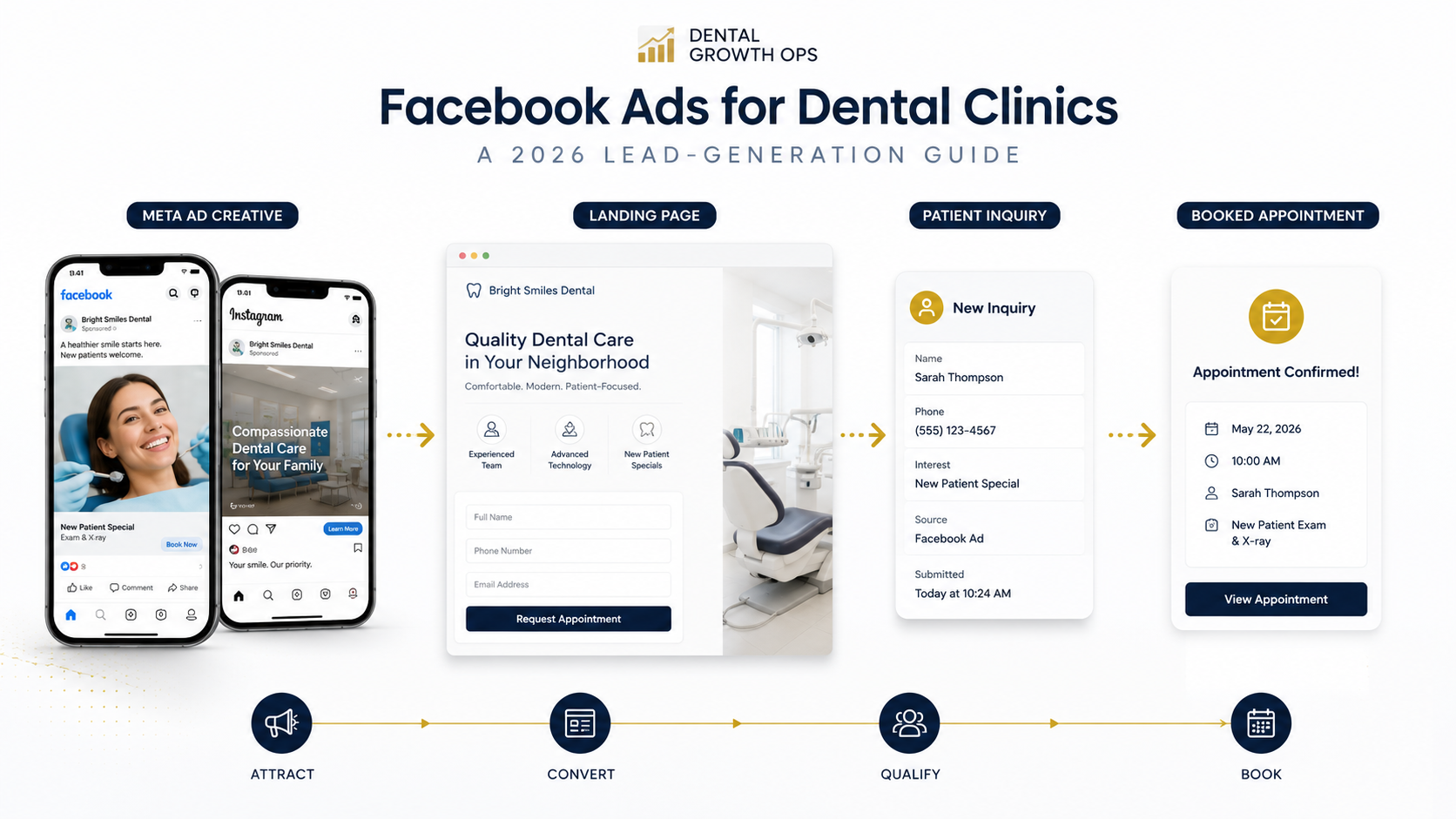
Facebook and Instagram ads work for dentistry, but only for the right treatments, with the right creative, and a funnel that converts leads into booked appointments. This 2026 guide covers everything from campaign structure to post-iOS14 measurement, so your Meta Ads budget turns into actual chair revenue.

Moaz Arshad
• 9 min read
Why Facebook Ads Work for Dentistry, When Done Right
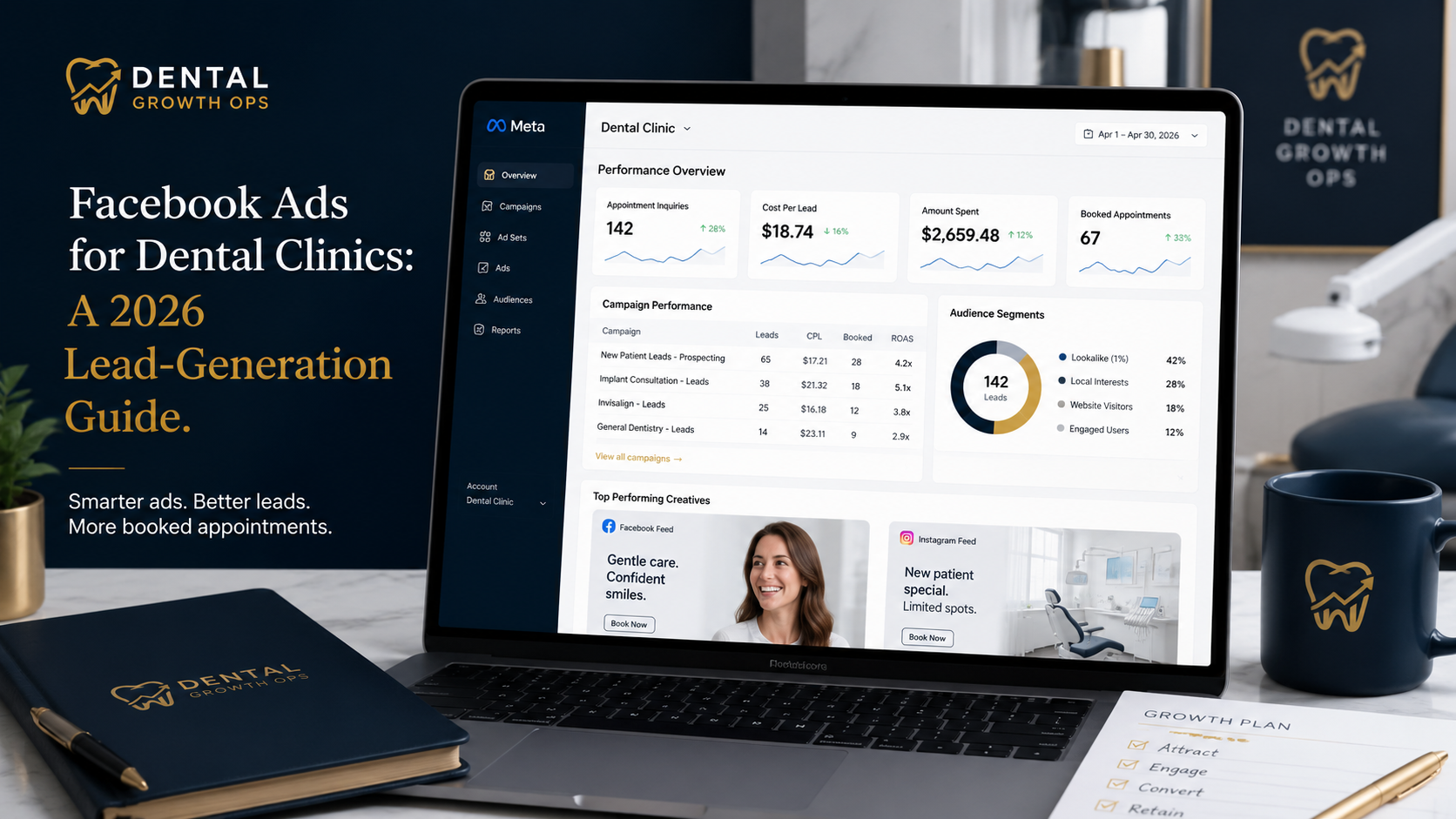
Facebook and Instagram ads are a fundamentally different channel than Google Ads. Google captures patients who are already searching (active, intent-driven demand). Meta Ads create demand; they interrupt patients who weren't searching for a dentist today but can be persuaded by the right message at the right moment.
This makes Meta Ads particularly well-suited for elective and cosmetic dental procedures: Invisalign, veneers, dental implants, and teeth whitening. A patient who has been silently dissatisfied with their smile for two years isn't searching "dental veneers [city]," but they'll stop their Instagram scroll for a compelling before/after video that speaks to their exact insecurity. Facebook ads for dental clinics work when they target the right treatments.
Treatment-Specific Campaign Structure
The biggest mistake dental practices make with Meta Ads is running a generic "new patients welcome" campaign targeting everyone in a 10-mile radius. Treatment-specific campaigns consistently outperform generic ones by a factor of 3–5x on cost per lead.
Segment your dental Facebook ads by treatment category:
- Invisalign / Clear Aligner campaign: target adults 22–45, middle-to-upper income, "interested in dental aesthetics"
- Dental Implants campaign: target adults 40–65, high income bracket, homeowner signals
- Cosmetic / Veneers campaign: target adults 28–50, interest signals around confidence, fashion, social media
- Teeth Whitening campaign: lower ticket, broader targeting, good for list building and reactivation
- New Patient General campaign: recently moved, life event targeting, low budget, broad geographic reach
Each campaign runs its own creative and landing page. The message for an implant campaign ("Stop living with dentures that slip") is completely different from an Invisalign campaign ("Get the smile you want before the school year starts").
Audience Targeting for Dental Clinics in 2026
Meta's targeting has matured since iOS14 reduced pixel accuracy, but it remains powerful when used correctly:
- Geo + income targeting: Target your practice's realistic service area (10–20 miles, not the whole metro), layered with household income signals for high-ticket treatments
- Lookalike audiences: Upload your existing patient list (email/phone, HIPAA-compliant via Meta's hashed upload system) and build 1–3% lookalike audiences. This is consistently the highest-performing cold audience for dental practices
- Life event targeting: "Recently moved" audiences convert extremely well for general dentistry, since people in a new city actively need a new dentist
- Retargeting: Build custom audiences from website visitors, video viewers (25%+ completion), and lead form openers who didn't submit
Creative That Converts in 2026
Video consistently outperforms static creative for dental Facebook ads, specifically 15–30 second videos that open with the patient problem, not the practice name. The first 3 seconds must stop the scroll.
- Before/after videos (with explicit patient consent) perform best for cosmetic procedures. HIPAA requires written authorization for patient images used in advertising.
- Dentist-to-camera videos build trust fastest. 30 seconds of the practice owner speaking directly to the camera about a specific treatment, conversational rather than scripted, outperforms professionally produced ads in most dental markets.
- Patient testimonial videos handle the trust objection better than any other creative format. Keep them under 45 seconds and lead with the specific problem the patient had before treatment.
"A cosmetic dentistry practice generated 83 qualified leads in 30 days at $31 cost per lead; 34 converted to booked consultations, producing $67,000 in treatment plan value in month one."
Want This Done for Your Practice?
Our Meta Ads service handles campaign structure, creative strategy, audience setup, lead funnel, and monthly reporting. Dental-specific, no generalist work.
Book a Free Strategy CallPost-iOS14 Measurement: What to Track
iOS14's App Tracking Transparency framework significantly reduced Meta pixel accuracy, meaning Meta no longer sees every conversion that comes from an ad click. In 2026, the fix is Meta's Conversions API (CAPI), which sends conversion events server-side directly from your CRM or scheduling system to Meta's API, bypassing the browser/app tracking limitations.
CAPI implementation for a dental practice means: when a patient books an appointment in your scheduling system (triggered by a Meta ad lead), that booking event is sent directly to Meta from your server, not from a browser pixel. This restores most of the attribution accuracy lost to iOS14 and allows Meta's algorithm to optimize toward actual appointments, not just form submissions.
Without CAPI, you're optimizing toward leads that Meta can see, many of which may not be converting to booked appointments. With CAPI, you can feed your actual booked-appointment data back into Meta and let the algorithm find more patients who will actually schedule.
Budget and Cost Per Lead Benchmarks
Realistic dental Facebook and Instagram ad benchmarks for 2026:
- Minimum effective budget: $2,000/month (below this, you don't accumulate enough data to optimize)
- Recommended range: $3,000–$5,000/month for a single-location practice running 2–3 treatment campaigns
- Cost per lead (CPL): $25–$50 for general dentistry, $45–$80 for cosmetic, $70–$120 for implants
- Lead-to-booked rate: 35–60% with proper CRM follow-up (refer to the 12-minute response rule)
- ROAS: 6–14x on cosmetic campaigns with a working funnel; 3–6x on general new-patient campaigns
The gap between "good" and "great" performance on dental Meta Ads almost always comes down to lead follow-up speed. The best Meta Ads campaign in the world underperforms if leads wait 4 hours for a response. Wire up CRM automation to handle the first 12-minute response automatically, and your conversion rate from these campaigns climbs considerably.
Moaz Arshad
Founder of Dental Growth Ops. Dental-only marketing specialist focused on new patient acquisition, local SEO, and paid media for dental clinics in the US and Canada.
More about us →