
The 12-Minute Lead Response Rule Every Dental Practice Is Breaking
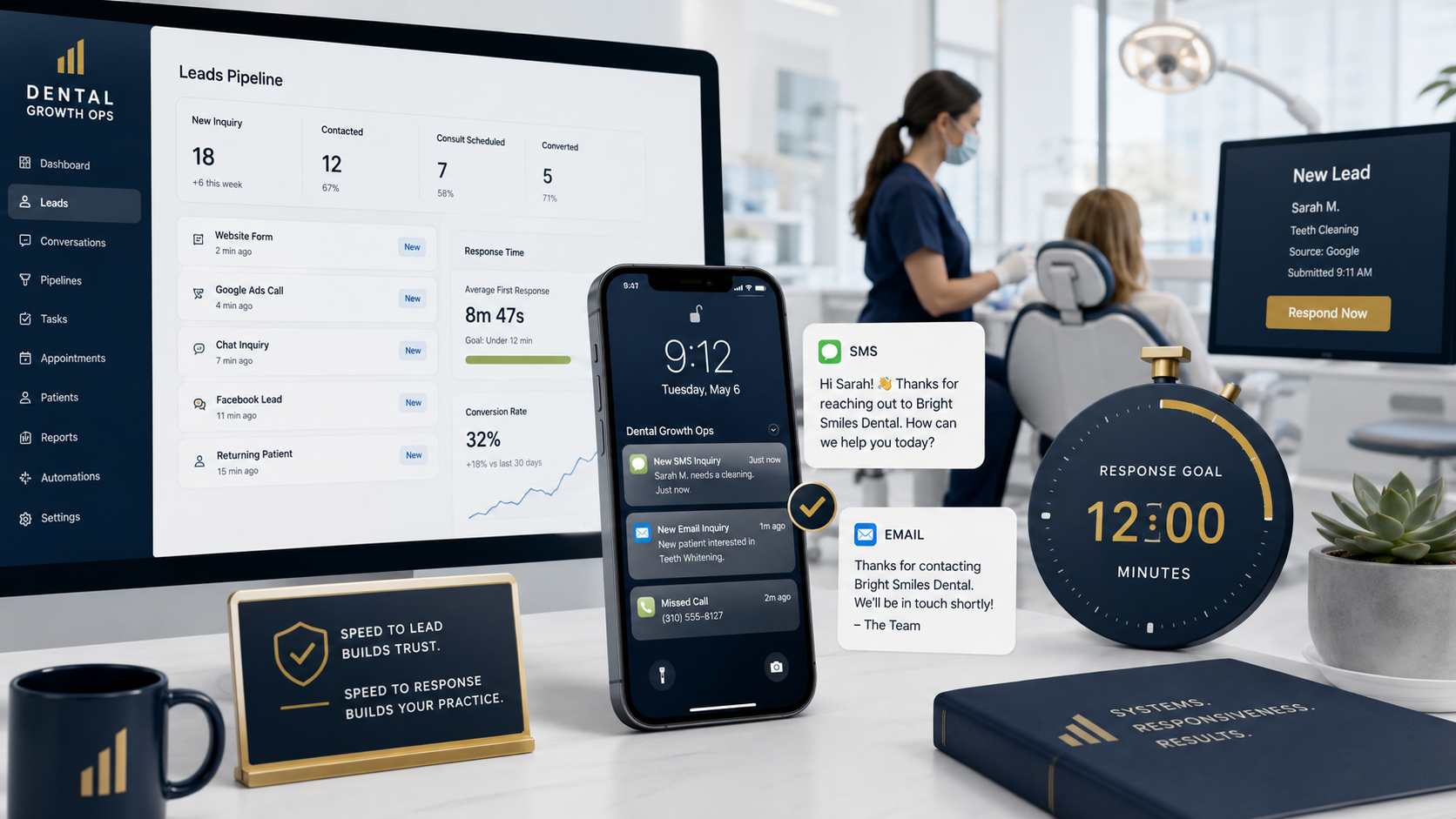
The data is clear: dental practices that respond to new patient inquiries within 12 minutes book appointments at three times the rate of those waiting an hour. Most practices wait two to four hours. That gap is costing practices tens of thousands of dollars in production every month, and it's completely fixable with automation.

Moaz Arshad
• 7 min read
The Speed-to-Lead Data Behind 12 Minutes
A landmark study published in the Harvard Business Review found that companies responding to leads within one hour were seven times more likely to convert those leads than companies responding even an hour later. The MIT Lead Response Management Study found that responding within five minutes made conversion 100 times more likely than responding after 30 minutes.
Dental practices operate in an even more time-sensitive environment. A patient searching "emergency dentist near me" at 2pm is in pain and motivated right now. By 4pm, they've booked with whoever answered first. The same dynamic applies to high-value elective procedures: a patient ready to move forward on implants or Invisalign today may have cooled off, changed their mind, or booked elsewhere by tomorrow morning.
Across dental practices we've analyzed, the average internal response time to a new patient web inquiry is 2–4 hours. The practices consistently converting inquiries at the highest rate respond within 12 minutes, often via automated systems, not manual calls.
Why Dental Leads Decay Faster Than Any Other Industry
Three factors make dental leads uniquely time-sensitive:
- Pain-driven urgency. Many new patient inquiries are triggered by acute dental pain. Pain medication provides temporary relief. If you haven't responded within the hour, the urgency subsides, and so does the motivation to book.
- Multiple simultaneous searches. Patients searching for dentists rarely contact one practice. They submit 2–4 inquiry forms or make 2–3 phone calls simultaneously. Whoever responds first, and fastest, sets the frame for every subsequent conversation.
- Anxiety about going at all. Many patients have delayed dental care due to cost anxiety or dental fear. A slow response reinforces the subconscious excuse to delay further. A fast, warm response breaks through that resistance.
The $200,000 Problem Hiding in Your Missed Leads
Here's the production math that matters. Assume a dental practice generates 80 new patient inquiries per month, from organic search, Google Ads, social media, and referrals combined. At a 40% lead-to-book rate (slow response, manual follow-up), that's 32 new patients.
At a 70% lead-to-book rate (sub-12-minute automated response, structured follow-up), that's 56 new patients from the same 80 leads. The difference is 24 additional new patients per month. At an average new patient production value of $700 for the first visit, that's $16,800 in additional monthly production, or over $200,000 per year, from the exact same lead volume. No additional ad spend required.
"The most expensive thing a dental practice does is pay to generate a lead and then let it go cold. Speed-to-lead isn't a nice-to-have: it's the multiplier on every dollar of marketing spend."
What a 12-Minute Response System Looks Like
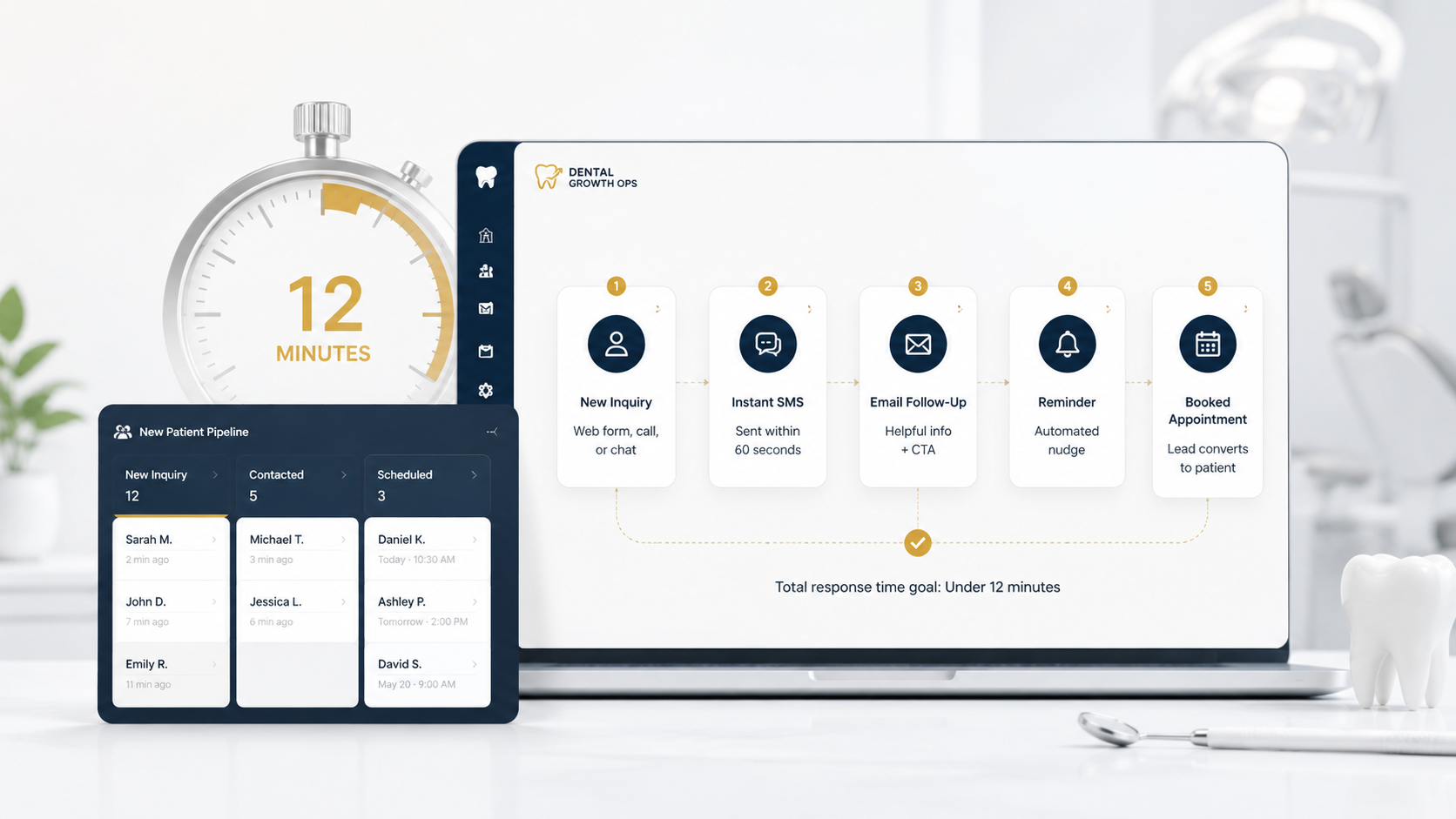
You can't rely on front desk staff to respond within 12 minutes every time. Front desk teams are busy: they're checking patients in, answering phones, running eligibility checks, and managing schedules. Expecting them to also monitor web inquiry notifications in real time isn't realistic. Automation removes the human dependency:
- Instant SMS auto-response (90 seconds). When a new patient submits a web inquiry, they receive an automated SMS within 90 seconds: "Hi [Name], thanks for reaching out to [Practice Name]! One of our team members will call you within the next 10 minutes to get you scheduled. If you need to reach us now, call [number]." This sets an expectation and keeps the patient from going elsewhere.
- Front desk notification and callback queue. The CRM simultaneously notifies the front desk team via app, desktop alert, or SMS that a new lead needs a callback, with the patient's name, inquiry type, and the 10-minute window they were promised.
- Automated follow-up sequence if no callback reached. If the patient doesn't answer the first call, an automated follow-up sequence sends a second SMS at 30 minutes, an email at 2 hours, another SMS at 24 hours, and a final follow-up at 72 hours. Each message is warm, conversational, and includes a direct booking link.
Want This System Running for Your Practice?
Our dental CRM automation service sets up the full response pipeline: instant SMS, callback queue, follow-up sequences, and booking integrations.
Book a Strategy CallWhat This System Runs On
Our dental CRM automation service builds this on GoHighLevel (GHL), a platform specifically suited to dental practice workflows. GHL integrates with most dental scheduling software and practice management systems, allowing automated responses to pull in patient names, map inquiry types to the right message templates, and route callbacks to specific team members.
The front desk team doesn't need to change their core workflow; they continue managing appointments through their existing software. The CRM layer handles the lead capture, initial response, and follow-up without adding manual steps to an already full schedule.
Combine Fast Response With Strong Ads and SEO
Speed-to-lead multiplies the ROI of every other marketing channel. Your Google Ads campaigns, local SEO rankings, and Meta Ads lead gen all produce inquiries. What you do in the 12 minutes after that inquiry arrives determines whether those channels produce patients or wasted spend. Fix the response system first, then scale the spend.
Moaz Arshad
Founder of Dental Growth Ops. Dental-only marketing specialist focused on new patient acquisition, local SEO, and paid media for dental clinics in the US and Canada.
More about us →