
Why Review Velocity Matters More Than Review Count for Dentists
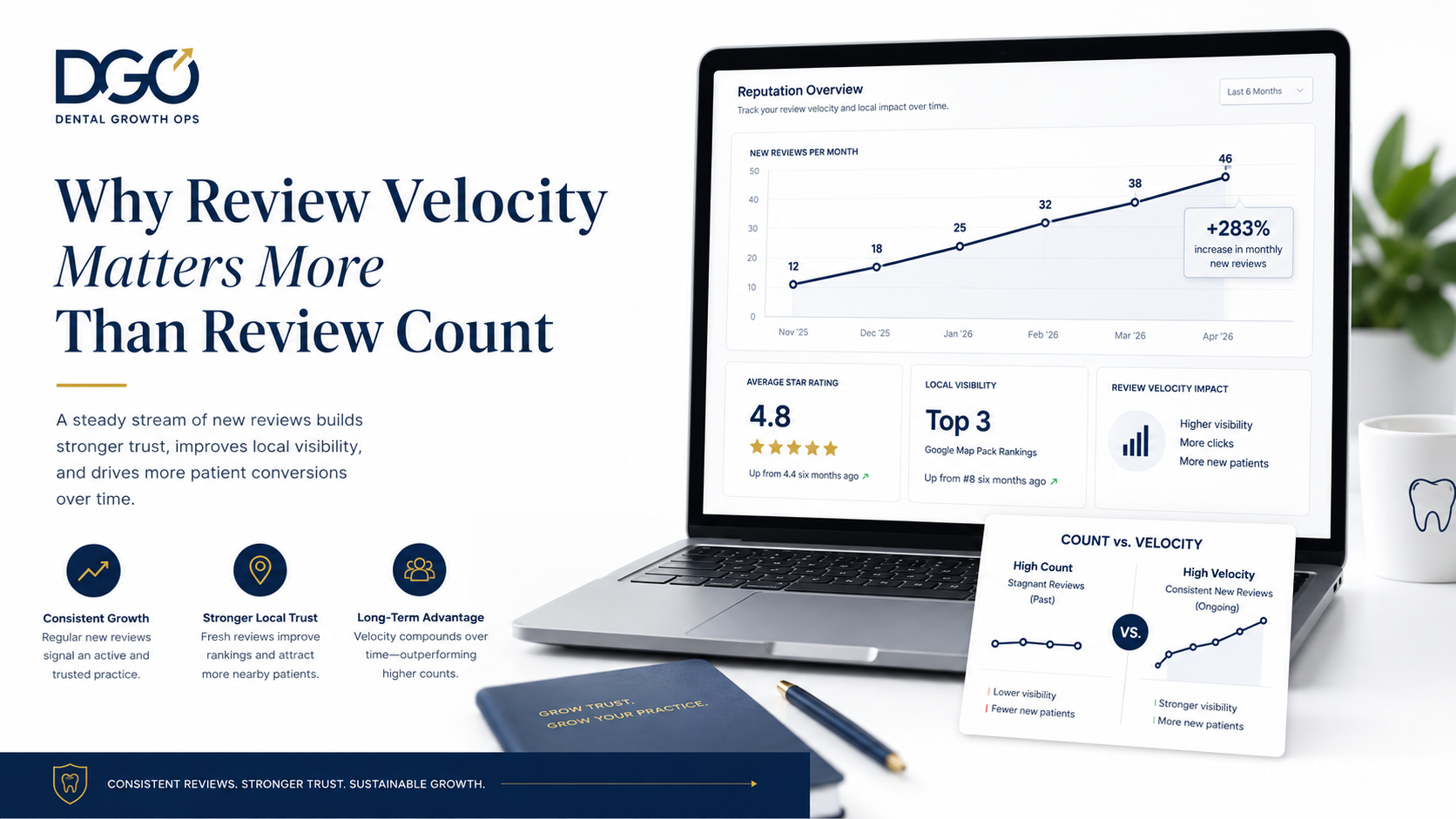
Dental practices with 40 recent Google reviews are consistently outranking competitors with 200 old ones. This counterintuitive pattern has a clear explanation: Google's local algorithm weights the recency of reviews heavily, and patients trust recent feedback far more than year-old ratings. Here's what review velocity is and how to build a sustainable engine for it.

Moaz Arshad
• 6 min read

The Velocity vs. Count Misconception
Most dental practice owners measure their review success by total count: "We have 180 Google reviews; we're doing well." Total count matters, but it's a lagging indicator. What Google actually evaluates in its local ranking algorithm is a combination of:
- Total review count (absolute prominence signal)
- Average star rating (quality signal)
- Review recency (activity signal)
- Owner response rate (engagement signal)
Recency is the signal most practices neglect. A practice that collected 180 reviews over five years (averaging 36 per year, or 3 per month) loses ranking authority to a newer competitor generating 15 reviews per month consistently. The newer competitor has a stronger review velocity signal even with a fraction of the total count.
Why Recency Matters to Patients Too
It's not just Google. According to BrightLocal's consumer research, 77% of patients consider a review irrelevant if it's more than one year old. When a prospective patient checks your Google listing and sees the most recent review is from eight months ago, they draw an unconscious conclusion: either the practice has slowed down, or they stopped asking for reviews because they have something to hide. Neither is the impression you want.
A review posted last week, by contrast, signals a busy, active practice, one that real patients are experiencing right now and feel motivated to tell others about.
What a Strong Review Velocity Looks Like in Practice
For a single-location dental practice, 8–15 new Google reviews per month represents strong velocity in most markets. Multi-location practices or DSOs in major metros should target 15–30 per location per month.
Achieving these numbers manually (asking patients at the front desk, putting a sign in the waiting room, or sending a one-time email blast) produces results in the single digits. Building a systematic, automated pipeline produces results consistently, month over month, regardless of front desk bandwidth.
"Practices that implement automated review velocity systems typically see their Google map pack ranking improve within 60–90 days, not because of the stars, but because Google sees them as an active, relevant local business receiving consistent community feedback."
Building a Review Velocity Engine for Your Practice
The highest-performing review collection systems share four common components:
- Timed post-visit trigger. The review request goes out 2–4 hours after the patient leaves, not immediately (too soon, feels transactional) and not the next day (too late, motivation fades). Automated via SMS and email simultaneously.
- Single-step Google link. The message contains a direct link to the Google review form, with no account login required and no platform navigation. Reduce steps, increase completion rate.
- Internal feedback capture first. Before routing satisfied patients to Google, patients are asked a quick 1-5 satisfaction question. This pre-screens feedback: highly satisfied patients go to Google, lower scores get routed to an internal feedback form so you can address the issue before it becomes a public negative review.
- 100% response rate target. Every review, whether 5-star or 1-star, receives an owner response within 24 hours. This signals engagement to Google and demonstrates professionalism to every prospective patient reading the reviews.
Want This Review Engine Running for Your Practice?
Our dental reputation management service builds the full automated system: timed requests, Google routing, internal feedback, and response management.
Book a Strategy CallHow to Handle Negative Reviews
Negative reviews are inevitable. The practices that handle them best, and maintain the highest ratings, treat each negative review as a public customer service opportunity. The response isn't written for the reviewer; it's written for the next 500 people who read it.
An effective negative review response: acknowledges the experience, expresses genuine concern without admission of fault, invites the patient to contact the practice directly to resolve the situation, and remains professional throughout. A measured, empathetic response to a 1-star review often reads better than the review itself.
Never dispute a review publicly, never delete or report reviews without merit, and never offer incentives for review removal: all violate Google's review policies. The best response to a pattern of negative feedback is generating enough positive reviews to dilute the impact.
Connect Review Velocity to Your Broader SEO Strategy
Review velocity is one of the four core pillars of dental local SEO. The others (Google Business Profile optimization, citation building, and location pages) create the foundation. Review velocity is what keeps that foundation active and compounding over time. Pair it with CRM automation to ensure post-visit review requests go out systematically without depending on front desk bandwidth.
Moaz Arshad
Founder of Dental Growth Ops. Dental-only marketing specialist focused on new patient acquisition, local SEO, and paid media for dental clinics in the US and Canada.
More about us →