
Dental Marketing Strategies: 15 Practical Ways to Grow Your Practice
Most practices do not have a dental marketing problem. They have a dozen disconnected activities and no system holding them together. This guide covers the dental marketing strategies that matter, the order to run them in, and how to tell which ones are producing booked patients rather than traffic.

Moaz Arshad
• 14 min read
What are the most effective dental marketing strategies?
The most effective dental marketing strategies work as one connected system rather than as separate campaigns. That system normally combines a conversion-focused website, local SEO and a well-maintained Google Business Profile, an active review process, paid search for high-intent treatments, retargeting and social media for familiarity, accurate call and form tracking, CRM with email and SMS automation for follow-up, and deliberate retention and reactivation of existing patients. Channels create or capture demand. CRM and follow-up convert and keep it. No single channel performs equally well for every practice, and the right mix depends on treatment focus, market, capacity and stage.
Key takeaways
- Marketing channels generate demand. Websites, CRM and follow-up convert it. Most practices overspend on the first and underbuild the second.
- Priority depends on stage. A new practice, a plateaued practice, an implant practice and a multi-location group should not run the same plan.
- Local SEO and reviews compound over time. Paid search buys visibility for as long as you fund it. Fund both when the budget allows.
- Response speed and follow-up consistency decide how many of the leads you already pay for become booked, attended patients.
- Measure booked patients, show rate, treatment presented and treatment accepted. Clicks and impressions say almost nothing about production.
- Fix tracking before increasing spend. You cannot prioritise a strategy whose contribution you cannot see.
What is a dental marketing strategy?
A dental marketing strategy is the documented decision about which patients and treatments a practice wants, how it will become visible to those people, how it will convert their interest into booked appointments, and how it will measure the result. It is a plan for the whole path, not a list of channels.
That definition matters because most of what gets called a strategy is really a tactic in isolation. Posting three times a week on Instagram is not a strategy. Running a Google Ads campaign is not a strategy. Those are activities, and activities without a strategy behind them are why practice owners so often say they tried marketing and it did not work.
A complete strategy connects eleven things, and weakness in any one of them limits everything downstream:
- Target market and catchment area
- Priority treatments and the production behind them
- Positioning, meaning why a patient would choose you over the practice two blocks away
- Demand generation and demand capture
- Website conversion
- Search visibility, organic and local
- Paid advertising
- Reviews and reputation
- Lead follow-up and response speed
- Retention, recall and reactivation
- Measurement and attribution
Notice how few of those are channels. Roughly half the list is operational: what happens after someone raises their hand. That imbalance is deliberate, and it is the single biggest difference between practices that grow from marketing and practices that spend on it.
How dental marketing works as a connected system
We organise every engagement around five stages. The framework exists because tactics fail quietly when the stage before or after them is broken, and the owner usually blames the wrong stage.
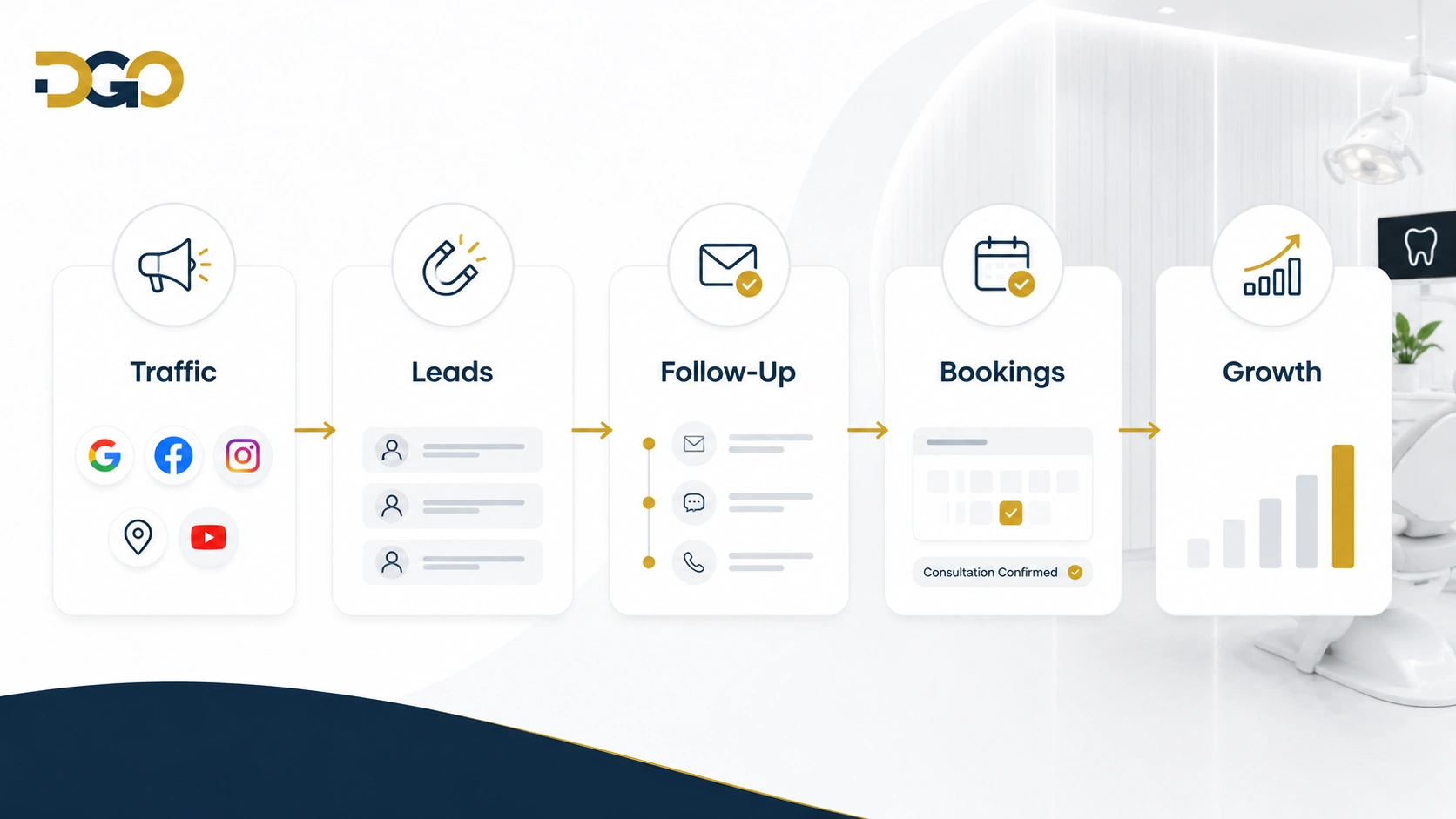
The five-stage dental marketing system
- 1. AttractSEO, Google Business Profile, ads, social, referrals
- 2. ConvertWebsite, landing pages, calls, forms, booking
- 3. Follow upCRM, speed to lead, email and SMS nurture
- 4. Book and attendScheduling, confirmations, reminders, no-show recovery
- 5. RetainRecall, reviews, reactivation, treatment follow-up
Stage 1: Attract
Local SEO, Google Business Profile, Google Ads, Meta Ads, organic social and patient referrals. This stage answers one question: does a person in your catchment who needs treatment encounter your practice at all? Everything here is measured in enquiries, not impressions.
Stage 2: Convert
Your website, treatment pages, landing pages, phone answering, contact forms, online booking and the trust signals around them. Attention arrives here and either becomes an enquiry or leaves. A 20% improvement at this stage costs far less than a 20% increase in ad budget and lifts every channel at once.
Stage 3: Follow up
The CRM, how fast a new enquiry is answered, what happens to a missed call, and the email and SMS sequences that run when someone does not book on the first contact. This is the stage most practices have never formally built, which is why it is usually where the largest recoverable loss sits.
Stage 4: Book and attend
Getting the appointment into the schedule, confirming it, reminding the patient, and having a process when they do not show. A booked appointment that no one attends produced nothing except a hole in the day.
Stage 5: Retain and reactivate
Recall, hygiene reappointment, unaccepted treatment plans, dormant patients, review requests and referrals. The cheapest new production in most practices is already in the patient database.
Isolated tactics underperform when the stages around them are disconnected. Paid traffic sent to a slow website is a Stage 2 problem. Leads that never get called back are a Stage 3 problem. Neither is fixed by increasing the ad budget.
The 15 dental marketing strategies
The strategies below are ordered roughly by dependency, not by importance. Later strategies get more valuable once the earlier ones exist. Read them as a sequence first, then choose your entry point using the practice-situation section further down.
1. Define the patients and treatments you want
Before any channel decision, decide what growth means for this practice. More new patients and more production are not the same goal, and they often pull in opposite directions.
A practice with open hygiene capacity needs volume. A practice booked six weeks out with a low case acceptance rate needs higher-value cases, not more exams. Work through service mix, chair and provider capacity, your realistic drive-time catchment, and your position on insurance and payment plans. A practice that accepts most plans is fishing in a much larger pond than a fee-for-service cosmetic practice, and the marketing looks nothing alike.
What to measure: production per new patient by treatment category, and open chair hours per week by provider type. Common mistake: positioning as a practice for everyone, which produces messaging that persuades no one and ad campaigns that compete on price.
2. Build a conversion-focused dental website
Your website is the only asset every other channel depends on. SEO, Google Ads, Meta Ads and social traffic all land here, so its conversion rate multiplies or divides everything you spend upstream.
The practical requirements are consistent across markets: fast loading on mobile data, a phone number that is tappable without scrolling, a booking or request path visible in the first screen, treatment pages that explain the procedure in patient language rather than clinical language, real photographs of the practice and providers, clear location and parking information, transparent insurance and financing details, and accessible markup with sufficient colour contrast and keyboard-navigable controls.
Google's SEO Starter Guide is the primary reference for the technical baseline that makes a site eligible to rank at all. Our own work on dental website development starts from conversion rather than aesthetics for exactly this reason, and the specific failure patterns we see most often are collected in our guide to dental website conversion mistakes.
What to measure: enquiries divided by sessions, by device and by landing page. Common mistake: redesigning for appearance without changing a single element that affects whether a visitor calls.
3. Optimise your Google Business Profile
For most general practices, the Google Business Profile is the single highest-return asset in local marketing. It appears above organic results, carries reviews, and offers direct call and direction actions.
The work is unglamorous and mostly one-time, then maintained: exact and consistent name, address and phone; correct primary category with relevant secondary categories; a complete services list with plain descriptions; genuine photographs updated periodically; opening hours including holiday exceptions; an appointment link that goes to a booking path rather than the homepage; and monitored questions and answers, because unanswered questions get answered by strangers. Google publishes the rules in its guidelines for representing your business on Google, and the naming rules in particular are worth reading before someone adds a keyword to the practice name.
Multi-location groups need a separate profile per physical location with a distinct local phone number, not one profile for the brand.
What to measure: calls, direction requests and website clicks from the profile, tracked against booked appointments. Common mistake: treating posting frequency as a ranking lever. Google does not publish local ranking weights, so treat any specific claim about post frequency or ranking factors as an assumption to test, not a fact.
4. Build a strong local SEO foundation
Local SEO is how a practice becomes the obvious answer for treatment searches inside its catchment. It compounds: the work you do this quarter keeps producing next year, which is the opposite of paid media.
The foundation has four parts. First, a dedicated page for each meaningful treatment, written for patients rather than for a keyword list. Second, genuine location relevance, meaning your address, service area, local landmarks and neighbourhood language appear naturally where they belong. Third, consistency of name, address and phone across your website, Google Business Profile and the directories that already list you. Fourth, technical health: crawlable pages, sensible internal links from your service pages to related treatments, correct canonical tags and a site that loads quickly on a phone.
Multi-location practices need a separate, genuinely distinct page per location. Duplicating one page and swapping the city name is the most common way this goes wrong. Our dental SEO services page covers how we structure this, and the map pack mechanics are covered in more depth in dental local SEO in 2026.
What to measure: calls and form fills from organic and from the map pack, plus rankings for treatment terms in your actual catchment rather than nationally. Common mistake: expecting local SEO to produce results on the same timeline as a paid campaign. It does not, and budgeting as though it will causes practices to abandon it just before it starts working.
5. Publish useful treatment and patient-education content
Patients research treatment before they call, especially anything expensive or frightening. Content marketing for a dental practice means answering those questions better than the sources they would otherwise find.
The topics that earn attention are consistent: what a procedure actually involves, what it costs and how it can be financed, recovery and aftercare, comparisons between options such as implants against bridges or clear aligners against fixed braces, and the specific anxieties that stop people booking. The differentiator is clinician input. A page written by a marketer reads like every other page on the subject. A page carrying your clinicians' actual answers to the questions they hear in the chair does not.
Content should also be maintained. Prices, materials, technology and regulations change, and a page that was accurate three years ago can now be quietly wrong.
What to measure: assisted conversions and enquiries from content pages, not pageviews. Common mistake: publishing to a keyword list rather than to a patient decision. If a page does not help someone decide something, it will not be read, cited or linked to.
6. Optimise for search and AI-powered answers
A growing share of patients now research treatment through AI Overviews, AI Mode and assistants such as ChatGPT and Perplexity before they ever see a list of blue links. This is worth taking seriously, and it is also where the most confident bad advice currently circulates.
Google's own documentation is unambiguous on this point. Its guidance on AI features and your website states that there are no additional requirements to appear in AI Overviews or AI Mode and no special optimisations necessary, and that you do not need to create new machine-readable files, AI text files or markup to appear in these features. Treat anyone selling an AI markup file as a ranking shortcut with appropriate scepticism.
What the same documentation does recommend is ordinary and durable: allow crawling, use internal links so pages are discoverable, deliver a good page experience, present important content as readable text rather than locking it inside images or scripts, include quality images and video, keep structured data aligned with what is visible on the page, and keep business information current. Add to that the things that make a passage quotable: a direct answer immediately after a question heading, clear definitions, accurate named entities such as your practice name, locations and providers, and reliable sources where a claim needs one.
What to measure: branded search volume and direct traffic alongside organic, since AI-assisted research often converts as a branded or direct visit later. Common mistake: generating dozens of near-duplicate question headings to farm extraction. It degrades the page for humans without reliably helping anything else.
7. Build a system for reviews and reputation
Reviews influence both whether you appear in local results and whether someone chooses you once you do. The practices that do this well have a process rather than good intentions.
A workable process names the person responsible, defines the moment to ask, which is normally at checkout after a positive visit or shortly after by message, uses a short link that goes directly to the review form, and responds to every review, positive and negative, in a measured and non-clinical voice that never discloses patient information. Negative feedback is also operational data: three reviews mentioning wait times is a scheduling problem, not a marketing problem.
Stay inside the platform rules. Google's prohibited and restricted content policy does not permit reviews posted as compensation, and states that merchants should not require or pressure users to leave reviews while on the premises. It does allow encouraging genuine reviews without offering incentives. Review gating, where you survey first and only route happy patients to Google, is the practice to avoid. We build this workflow as part of dental reputation management, and the reason recency matters as much as total count is explained in why review velocity matters more than review count.
What to measure: new reviews per month, average rating trend and response rate. Common mistake: a burst of 40 reviews in one week after two silent years, which looks exactly as unnatural as it is.
Are your marketing channels generating leads that never get followed up?
Dental Growth Ops connects websites, SEO, advertising, CRM, email and SMS follow-up into one measurable dental growth system. See how our engagements are structured, then book a call and we will map your five stages.
Book a Dental Marketing Strategy Call8. Use Google Ads for high-intent demand
Paid search is the fastest way to appear in front of someone who is actively looking for treatment today. It is also the fastest way to waste money, because you pay for every click including the irrelevant ones.
Structure campaigns by treatment rather than lumping everything into one. Emergency, implants, clear aligners and general dentistry have different searchers, different landing pages and different value per patient, and blending them hides which one is working. Target the radius patients realistically drive, not the whole metro. Send each campaign to a matching landing page: an implants ad landing on the homepage forces the visitor to find their own way, and most will not.
Negative keywords are where most of the recoverable waste sits. Google Ads documentation on negative keywords explains the match types, and dental accounts almost always need to exclude searches around jobs, courses, "dental nurse", "free", "school" and competitor brand terms you do not want to pay for. Review the search terms report regularly rather than once at launch.
Track calls and forms as conversions, and connect them through to booked appointments. Optimising to form fills alone rewards the campaign that generates the most enquiries, which is not always the campaign generating patients. Our Google Ads for dentists service covers this structure, and what a $5,000 monthly Google Ads budget actually buys covers the allocation question in detail.
What to measure: cost per booked patient and cost per attended patient by campaign, not cost per click. Common mistake: judging paid search on lead volume while the front desk is failing to answer the phone. That combination makes a working campaign look broken.
9. Use Meta Ads for education, demand creation and retargeting
Search captures people who already know they want something. Meta reaches people who are not looking yet, which makes it a different tool with a different job.
It works best for treatments with a visible outcome and a considered decision: clear aligners, veneers, whitening, implants. Creative should educate and reassure, showing the practice, the provider and the process. It also does the job nothing else does well, which is retargeting: the person who read your implant page and left is far cheaper to bring back than to find again.
Two constraints matter. First, healthcare and cosmetic advertising is a restricted category. Meta's health and wellness advertising standards require cosmetic procedure ads to be targeted to people 18 and over, and prohibit content that attacks or implies inferiority about someone's appearance, which rules out a lot of conventional before-and-after ad copy. Second, social leads arrive colder than search leads and will not convert without follow-up. A lead form that no one calls back within the hour is a subscription you pay for and do not use. Our Facebook and Instagram ads service exists for this channel specifically, and the campaign mechanics are covered in our Facebook ads for dental clinics playbook.
What to measure: cost per booked consultation and the contact rate on social leads. Common mistake: judging Meta on the same cost per lead as search. It usually produces cheaper leads that convert at a lower rate, and the honest comparison is at the booked-patient level.
10. Track every call, form, booking and lead source
You cannot prioritise strategies whose contribution you cannot see. Attribution is not an optional refinement, it is the thing that makes every other decision in this article possible.
The practical setup has five parts: a unique tracking number per marketing channel so calls are attributable; source capture on every web form; UTM parameters on every campaign link; conversion events in GA4 for calls, forms and booking completions; and, most importantly, source recorded in the CRM and carried through to the appointment that eventually happens. That last link is where attribution usually breaks, and it is why so many practices can report cost per lead but not cost per patient.
| Metric | What it tells the practice |
|---|---|
| Enquiries | Demand generated |
| Contact rate | Follow-up performance |
| Booking rate | Conversion performance |
| Show rate | Appointment quality and reminders |
| Cost per booked patient | Acquisition efficiency |
| Treatment presented | Opportunity value |
| Treatment accepted | Commercial outcome |
What to measure: the seven rows above, monthly, by lead source. Common mistake: reporting on sessions, impressions and follower counts. They describe activity, not production, and they are the metrics an underperforming campaign hides behind.
11. Respond to new leads quickly
Speed to lead is the highest-leverage operational change available to most practices, because it costs nothing in media and improves the return on every channel simultaneously.
The mechanism is simple. Someone submitting a form at 11am is usually contacting two or three practices, and the first useful reply shapes the decision. The build has four parts: an instant automated acknowledgement that confirms a human is coming, a task assigned to a named person rather than a shared inbox, missed-call text-back so an unanswered phone becomes a conversation instead of a lost patient, and a defined after-hours path so the enquiry that arrives at 8pm is not first seen at 9am the next day.
Response speed does not create demand and will not rescue a weak offer or a poor patient experience. What it does is stop you losing enquiries you have already paid to generate. We cover the operational detail in the lead response rule most dental practices are breaking, and the automation layer is part of our dental CRM automation work.
What to measure: median time to first human contact, and contact rate by hour of day. Common mistake: measuring the automated reply as the response. The patient is waiting for a person.
12. Use dental CRM and email and SMS automation
A CRM turns marketing from a series of separate campaigns into a pipeline you can see. Every enquiry from every channel lands in one place with its source attached, and moves through defined stages until it becomes a patient or does not.
The workflows worth building first are the ones covering predictable gaps: immediate lead response, nurture sequences for people who enquired but did not book, appointment confirmations and reminders, no-show recovery, treatment-plan follow-up after a consultation, reactivation for overdue patients, and review requests after a completed visit. Each one is a conversation the front desk would have if it had unlimited time, which it does not.
Automation supports the front desk; it does not replace clinical or human communication. The correct use is to handle timing, reminders and the first touch so that your team spends its attention on conversations that need a person. A practice that automates away the human contact gets efficient at annoying people. Assign an owner for the pipeline, or the CRM becomes an expensive list.
What to measure: contact rate, booking rate and pipeline stage conversion by source, plus appointments recovered from no-show and reactivation workflows. Common mistake: buying the software and never defining who is responsible for the pipeline each day.
13. Reactivate dormant and overdue patients
The cheapest production available to most practices is already in the database: patients overdue for recall, hygiene reappointments never scheduled, and treatment plans presented but never accepted.
Segment before you send. Overdue hygiene, unaccepted treatment over a certain value, patients not seen in 18 months and patients who moved away are four different conversations. Write for the segment, keep the message short, make booking a single tap, and honour opt-outs immediately and permanently. Message frequency and consent requirements for SMS and email differ by jurisdiction and are governed by law and by your regulator, so confirm your obligations with your own professional advisers rather than assuming a platform handles it for you.
What to measure: appointments booked and attended per campaign, and production from reactivated patients. Never sends or opens. Common mistake: a single mass message to the whole database, which generates opt-outs and burns a list you can only use once.
14. Use social media and video to build familiarity
Organic social rarely produces direct bookings at meaningful volume. What it does is make an unfamiliar practice familiar, which changes the conversion rate of every other channel.
The content that works is not complicated: provider introductions so a nervous patient knows who they will meet, short answers to the questions asked most often in the chair, a look at the practice environment, treatment explanations in plain language, and community involvement. Short-form video outperforms static posts for reach, and one filming session can produce several weeks of material reused across platforms. Consistency beats volume.
Judge it on the right terms. Followers and likes are not the objective. We treat dental social media marketing as a trust and retargeting asset that supports conversion, not as a replacement for high-intent channels.
What to measure: branded search volume, direct traffic, and retargeting performance against audiences built from social engagement. Common mistake: posting daily to an audience of existing patients and competitors, then concluding the channel does not work.
15. Improve retention, referrals and patient experience
Every strategy above becomes more profitable when patients stay. Retention is a marketing strategy even though it is executed almost entirely by the clinical and front-desk team.
The components are a recall system that actually rebooks rather than sends reminders into a void, consistent post-treatment follow-up, a defined moment to request a review, a straightforward way for happy patients to refer friends and family, and treatment education that helps patients understand why the plan matters. Collect feedback and act on it: the operational irritations patients mention quietly are the same ones they eventually mention publicly.
This is also where marketing and operations meet. If new patients arrive faster than the practice can see them well, growth damages the experience and the reviews follow. Fix capacity before scaling acquisition. For wider practice management and professional guidance alongside this, the American Dental Association and the Canadian Dental Association are the primary professional bodies in the two markets we serve.
What to measure: recall reappointment rate, patient retention over 24 months, referrals per month and reviews generated. Common mistake: funding acquisition heavily while the recall list quietly leaks more patients per month than the ads bring in.
Dental marketing strategy comparison
No performance figures appear below, because any number would depend on your market, treatment mix and execution. What the table does compare is how quickly each strategy tells you whether it is working, and how much value it retains once you stop paying for it.
| Strategy | Main goal | Speed of feedback | Long-term value | Best for |
|---|---|---|---|---|
| 1. Patient and treatment focus | Direction | Immediate | Compounding | Every practice, first |
| 2. Conversion-focused website | Convert | Moderate | Compounding | Any practice running paid or organic traffic |
| 3. Google Business Profile | Attract | Fast | Compounding | All local practices |
| 4. Local SEO foundation | Attract | Slow | Compounding | Practices planning beyond one quarter |
| 5. Patient-education content | Attract and convert | Slow | Compounding | High-consideration treatments |
| 6. Search and AI answer readiness | Attract | Slow | Compounding | Practices with existing content depth |
| 7. Reviews and reputation | Attract and convert | Moderate | Compounding | All practices |
| 8. Google Ads | Attract | Fast | Short-term | Open capacity, high-intent treatments |
| 9. Meta Ads and retargeting | Attract | Fast | Short-term | Cosmetic, aligners, implants |
| 10. Tracking and attribution | Measure | Fast | Compounding | Any practice spending on media |
| 11. Speed to lead | Convert | Fast | Compounding | Practices already generating enquiries |
| 12. CRM and automation | Convert and retain | Moderate | Compounding | Multi-channel and multi-location practices |
| 13. Reactivation | Retain | Fast | Short-term per campaign | Practices with a large patient database |
| 14. Social media and video | Familiarity | Slow | Compounding | Practices with a distinctive team or environment |
| 15. Retention and referrals | Retain | Moderate | Compounding | Established practices |
Which dental marketing strategies should you start with?
The correct starting point is the stage where you are losing the most, which is rarely the stage that feels most urgent. Four common situations:
New or recently opened practice
You have no reviews, no rankings and no database, so the compounding strategies have not started compounding yet. Build the website, complete the Google Business Profile properly, put the local SEO foundation in place, start the review process from your first patient, and instrument tracking before you spend anything. Add Google Ads if budget allows, because it is the only strategy here that produces enquiries in week one while the rest mature.
Established practice with inconsistent growth
You are already generating enquiries, so start by auditing what happens to them rather than buying more. Check the website's conversion path, measure how quickly calls and forms are actually answered, and get attribution working end to end. In most practices in this situation, the recoverable gain in Stages 2 and 3 is larger than anything an increased ad budget would produce. Then strengthen local SEO and rebuild paid search around treatment-level campaigns.
Cosmetic or implant practice
Your patients take weeks or months to decide and your cases are worth multiples of a routine exam, so the follow-up layer matters more than the acquisition layer. Build dedicated treatment landing pages, run search campaigns on the specific procedures, invest in patient education and video, and put real work into consultation-to-acceptance follow-up. A consultation that does not convert is not a lost lead, it is a lead that needs a sequence.
Multi-location group or DSO
Your problem is structural before it is tactical. Give each location its own genuinely distinct page and its own Google Business Profile with a local number, run one CRM with separate pipelines per location, standardise the follow-up process so performance differences reflect the market rather than the front desk, and build centralised reporting that shows cost per booked patient by location and source. Without that, budget gets allocated on anecdote.
A 90-day dental marketing strategy plan
Ninety days is long enough to build the foundation and see early signal, and not long enough for local SEO or content to mature. Plan accordingly: the compounding strategies are started in this window, not completed in it.
90-day plan at a glance
- Days 1 to 30Foundation and measurement
- Days 31 to 60Visibility and acquisition
- Days 61 to 90Conversion and optimisation
Days 1 to 30: foundation and measurement
- Audit every current channel and record what each one costs and produces today
- Agree the practice goal: volume, treatment value, or a specific location or provider
- Fix tracking. Call tracking numbers, form source capture, UTMs, GA4 conversion events
- Review the website's conversion path on a phone, not a desktop
- Complete the Google Business Profile and correct any name, address and phone inconsistencies
- Define CRM pipeline stages and name the person who owns the pipeline daily
- Record baseline numbers for every metric in the scorecard below
Days 31 to 60: visibility and acquisition
- Improve or rebuild the priority treatment pages
- Begin the local SEO work: internal links, location relevance, technical fixes, citation consistency
- Launch or rebuild paid campaigns by treatment, with matching landing pages and a negative keyword list
- Publish the first patient-education pages with genuine clinician input
- Turn the review process on and keep it running weekly
- Connect every lead source into the CRM so source survives to the appointment
Days 61 to 90: conversion and optimisation
- Review lead quality by source, not just lead volume
- Tighten response workflows using the contact-rate data you now have
- Test landing page changes on the highest-spend campaign
- Cut wasted spend using the search terms report and campaign-level booked-patient data
- Add nurture and reactivation workflows now that the pipeline is populated
- Review booked patients, show rate and treatment accepted against the day-one baseline
- Plan the next quarter from what the data showed, not from what was assumed in month one
Be realistic about what this window proves. Paid search and reactivation give a readable answer inside 90 days. Local SEO, content and reputation are usually still building, and judging them on this timeline is how practices abandon the strategies that would have produced the most durable results. If you need to model the spend behind this plan, our guide on how much a dental practice should spend on marketing works the number backward from patient targets.
How to measure a dental marketing strategy
Metrics fall into four tiers, and the mistake is reporting the first tier while believing you are reporting the fourth.
- Visibility metrics: impressions, rankings, reach, profile views. Useful as leading indicators, worthless as outcomes.
- Lead metrics: calls, forms, chats, lead quality by source. The first tier that reflects real demand.
- Appointment metrics: contact rate, booking rate, show rate, cost per booked and attended patient. Where marketing and operations meet.
- Treatment and revenue metrics: treatment presented, treatment accepted, production per new patient, reactivated patients. The tier that answers whether any of it was worth doing.
A workable monthly scorecard has one line per source and these columns: enquiries, contact rate, booking rate, show rate, cost per attended patient, treatment presented, treatment accepted, and reviews generated. Review it every 30 days, change one thing at a time, and give each change enough data before judging it. Attribute revenue only where the chain from enquiry to appointment is genuinely intact; a confident number built on a broken chain is worse than no number.
Common dental marketing mistakes
These are the patterns we see most often when we audit an existing programme, roughly in order of how much they cost:
- Marketing every treatment equally. Attention and budget spread evenly across ten services funds none of them past the threshold where they work.
- Sending paid traffic to a generic homepage. The visitor searched for one thing and has to go looking for it.
- Measuring clicks instead of booked patients. The two often move in opposite directions.
- Ignoring calls and missed calls. The most expensive leads a practice buys are frequently the ones nobody answered.
- Using disconnected tools. A website form, a spreadsheet, a separate SMS app and a practice management system that never speak to each other produce work but no visibility.
- Responding too slowly. Every hour of delay competes against practices that replied already.
- Publishing generic content. Pages written for a keyword rather than a patient decision are not read, cited or linked to.
- Neglecting reviews. Silence for a year followed by a burst helps less than a steady, genuine flow.
- Failing to track sources. Without attribution, budget decisions default to whoever argues most confidently.
- Changing strategy before enough data exists. Three weeks is not a test.
- Depending entirely on one channel. A single algorithm change or a competitor with a larger budget becomes an existential problem.
- Expecting automation to fix a weak offer or a poor patient experience. It will simply deliver the same problem faster and to more people.
Should a dental practice hire a marketing agency?
Sometimes, and it depends far more on operational readiness than on budget size. An honest answer cuts both ways.
An agency tends to be worth it when the practice is running several channels at once and no one internally owns them, when paid media is complex enough that mistakes are expensive, when there are technical SEO problems nobody on the team can diagnose, when reporting is weak enough that budget decisions are guesses, when CRM and automation need integrating with the practice management system, or when multiple locations need consistent processes and comparable reporting.
A practice is usually not ready when there is no operational capacity to see more patients, when service priorities have not been decided, when nobody is assigned to follow up leads, when the budget cannot fund a single channel past its minimum viable spend, or when the practice is unwilling to share account access and measure outcomes. In those cases an agency accelerates a problem rather than solving one, and the responsible answer is to fix the constraint first.
If you do engage one, insist on owning your own ad accounts, analytics and CRM data, on seeing ad spend and management fees as separate line items, and on reporting that goes down to booked and attended patients. You can see how we structure engagements on our dental marketing pricing page, what we cover across our services, and the results we publish in our case studies.
Putting a dental marketing strategy together
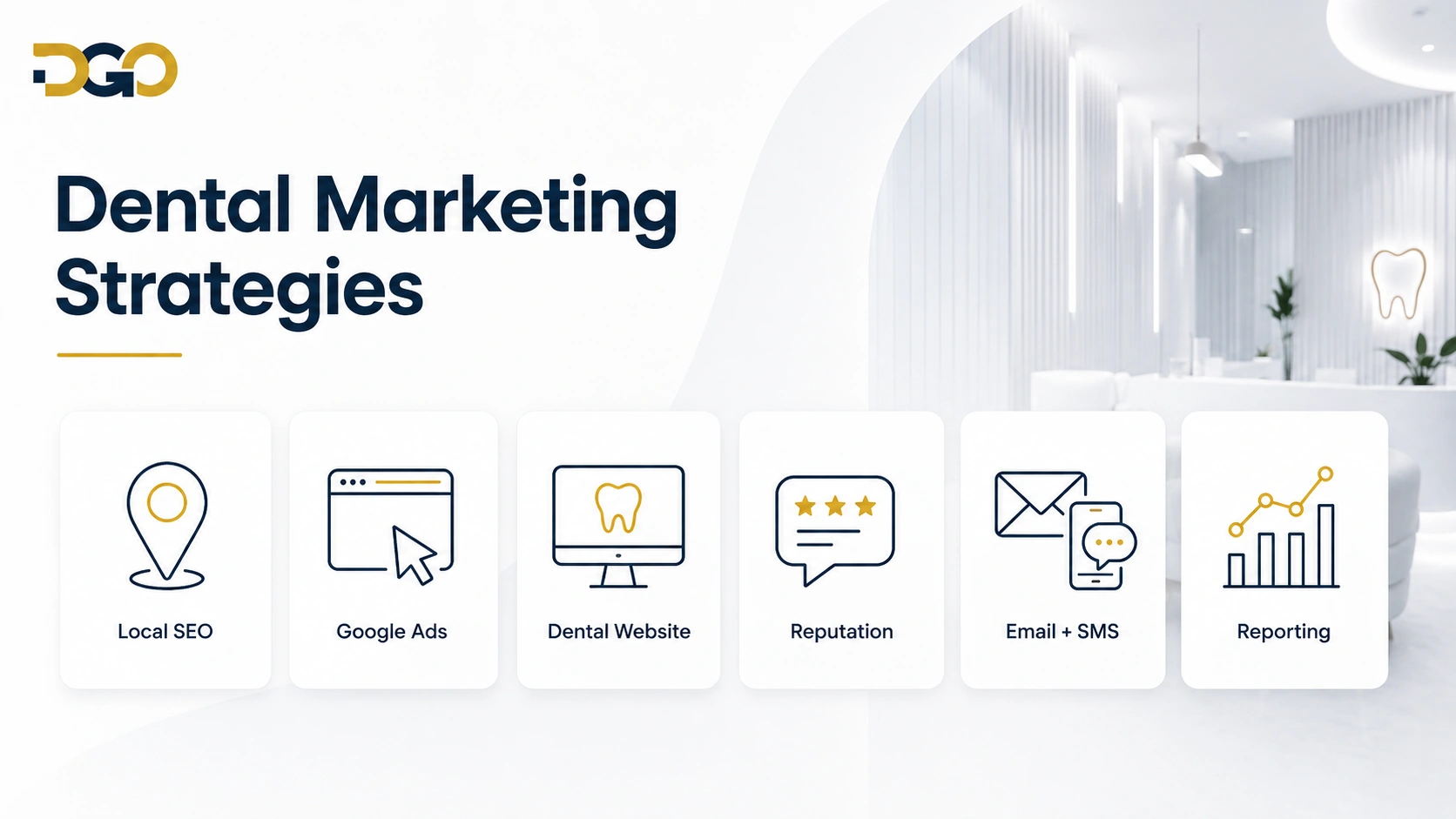
The strongest dental marketing strategy is not a collection of channels. It is a system that attracts the right patients, makes it easy for them to book, follows up consistently, and shows the practice what produced the result.
Start from what the practice is actually trying to achieve rather than from a list of tactics. Decide which patients and treatments matter, then work out which stage is leaking. Generating demand and converting demand are different problems with different solutions, and confusing the two is why practices spend more each year for the same number of patients. Get tracking in place before increasing spend, review it every 30 days, and change one thing at a time.
If you would like a second opinion on which stage is costing you the most, get in touch and we will walk through your channels, your follow-up and your numbers with you. You can also read more about how we work before you do.
Moaz Arshad
Founder of Dental Growth Ops. Dental-only marketing specialist focused on new patient acquisition, local SEO, and paid media for dental clinics in the US and Canada.
More about us →