
Dental Marketing Dallas: How to Grow a Dental Practice in North Texas
Dallas is not one dental market. It is dozens of overlapping neighborhood markets stacked inside one metro, and a practice in Preston Hollow competes for a completely different patient than a practice in Garland. This guide explains how dental marketing in Dallas actually works, which channels apply to which treatments, and how to tell whether any of it is producing booked patients.

Moaz Arshad
• 17 min read
What is dental marketing in Dallas?
Dental marketing in Dallas is the combined work of making a practice visible to patients inside its realistic drive-time catchment and converting that visibility into booked, attended appointments. In practice it combines local SEO, an optimised Google Business Profile, a conversion-focused website with treatment-specific pages, Google Ads for high-intent searches, Meta Ads for awareness and retargeting, an active review process, CRM automation with email and SMS follow-up, patient reactivation, and measurement that runs through to cost per booked patient. Dallas is geographically large and competitively uneven, so the correct channel mix depends on neighborhood, treatment focus and chair capacity rather than on a standard package.
Key takeaways
- Dallas dental marketing is won at neighborhood level. Drive time defines your patient pool, not the city boundary, so competing "in Dallas" is the wrong frame.
- Google Maps and organic search capture demand that already exists. Google Ads buys visibility immediately. Meta Ads creates awareness for treatments nobody searches for on a bad tooth day.
- Website conversion is a multiplier on every channel above it. A better conversion rate improves SEO, paid search and social at the same time, and usually costs less than raising the ad budget.
- CRM automation is what stops paid and organic enquiries from decaying in a voicemail box. Speed to lead and structured follow-up decide how many enquiries become attended patients.
- Measure cost per booked patient, show rate, treatment presented and treatment accepted. Clicks, impressions and rankings tell you nothing about production.
Why Dental Marketing in Dallas Is Different
Most dental marketing advice is written as though a practice competes against every other practice in its city. In Dallas that assumption breaks immediately, and building a plan on it wastes money in a specific and predictable way.
Dallas is one of the largest metropolitan areas in the United States, and it is sprawling rather than dense. A patient in Frisco is not going to drive to Oak Cliff for a hygiene visit. A patient in Mesquite is not shopping the same set of practices as a patient in University Park. The functional unit of competition is the drive-time catchment around your chair, which for routine treatment is usually a small number of miles and for high-value treatment can be considerably wider. Everything downstream, keyword targeting, ad geotargeting, review strategy and content, should be built on that catchment rather than on the word "Dallas".
Competition is uneven across the metro
Density of practices varies sharply. Corridors through North Dallas, Uptown, Preston Hollow, Plano, Frisco and Addison carry heavy concentrations of general and cosmetic practices, which raises the cost of visibility and the standard of the websites you are measured against. Other parts of the metro are less saturated, where a well-optimised Google Business Profile and a competent website can produce visibility that would take considerably more work a few miles north.
This has a direct budget consequence. Two practices, both in "Dallas", can face very different auction pressure in Google Ads and very different review benchmarks in the map pack. Any agency quoting the same plan and the same expectations for both has not looked at either market.
Demand differs by treatment, not just by geography
General dentistry, emergency dentistry, implants, clear aligners, cosmetic work and pediatric dentistry behave like separate markets that happen to share a building.
- Emergency and general searches are immediate and local. The patient wants the nearest practice that can see them, and proximity and reviews carry most of the decision.
- Implants, full-arch and cosmetic cases involve weeks or months of research, a much wider travel radius, and a decision that is as much about trust as about price. Highland Park, University Park, Preston Hollow and the North Dallas corridor concentrate a lot of this demand, and the follow-up layer matters more here than the acquisition layer.
- Orthodontic and pediatric demand follows families and school catchments, which is why suburban growth areas such as Frisco, Plano, Richardson and Carrollton behave differently from the urban core.
- Corporate corridors such as Las Colinas and Downtown Dallas produce weekday, near-work searching rather than near-home searching, which changes both hours and geotargeting.
Google Maps carries disproportionate weight
For most Dallas practices the Google Business Profile is the highest-leverage asset in the entire programme, because the map results sit above organic listings and offer direct call and directions actions. A patient searching on a phone frequently never scrolls past the map. That makes profile completeness, proximity, category accuracy and review activity the practical gatekeepers of local visibility.
Google does not publish local ranking weights. Treat any specific percentage or ranking-factor claim you read about the map pack as an assumption to test in your own market, not as a fact.
Reputation standards are set locally
The review bar in a competitive Dallas corridor is set by whoever your patients see next to you in the map results, not by a national average. The practical test is not "do we have enough reviews" but "how do we look next to the three practices we appear beside on a phone". That comparison, done honestly, tells you more than any benchmark article. BrightLocal's ongoing consumer review research is a reasonable place to understand general patient behaviour around reviews, but the standard you have to clear is the one on your own screen.
How Dallas Patients Find a Dentist
Before choosing channels, it helps to look at the path a Dallas patient actually walks. It is remarkably consistent, and almost every marketing failure we audit is a break at one specific point on it.
- Search. A phone search, usually with intent attached: "dentist near me", "emergency dentist", "dental implants", or a treatment plus a neighborhood.
- Map results. Three local listings appear above everything else, with ratings, distance and a call button.
- Reviews. The patient reads recent reviews, not the total count, and forms a first opinion in under a minute.
- Website. They tap through to check the practice is real, current, and treats what they need.
- Treatment page. For anything beyond a checkup, they look for a page about their specific procedure, cost and financing.
- Contact. They call, submit a form, or book online. Many do this from a parking lot or a sofa, on a phone, on the first attempt only.
- Follow-up. If nobody answers, they call the next practice. If someone does answer, or replies quickly, the practice is now in a shortlist of one.
- Appointment. Booked, confirmed, reminded and attended, or quietly lost between any two of those four.
Compressed into a framework, the Dallas patient journey is:
Search → Trust → Conversion → Follow-Up → Booking
Most practices invest heavily in the first step and almost nothing in the fourth. That is why so many Dallas practices can show rising traffic and flat production in the same quarter.
The Dental Growth Ops Dallas Marketing Framework
We organise every engagement around five stages. The framework exists because tactics fail quietly when the stage before or after them is broken, and the owner usually blames the wrong stage.
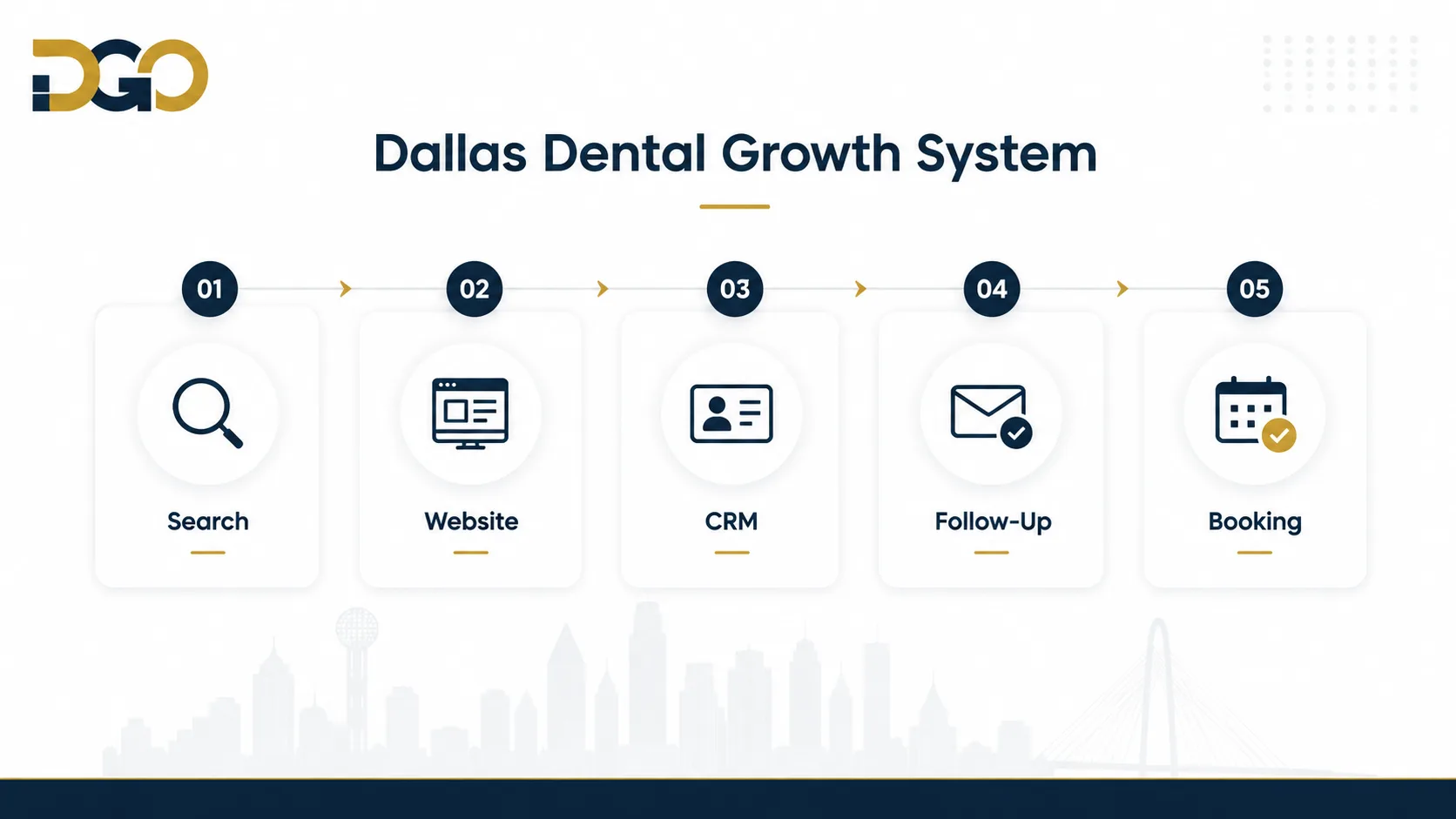
The Dallas dental patient acquisition system
- 1. AttractLocal SEO, Google Business Profile, Google Ads, Meta Ads, referrals
- 2. ConvertWebsite, treatment pages, calls, forms, online booking
- 3. Follow upCRM, speed to lead, missed-call text-back, email and SMS
- 4. BookScheduling, confirmations, reminders, no-show recovery
- 5. RetainReviews, recall, reactivation, referrals
Stage 1: Attract
Local SEO, Google Business Profile, Google Ads, Meta Ads and patient referrals. This stage answers one question: does a person inside your catchment who needs treatment encounter your practice at all? It is measured in enquiries, never in impressions.
Stage 2: Convert
Your website, treatment pages, phone answering, contact forms, online booking and the trust signals around them. Attention arrives here and either becomes an enquiry or leaves for a competitor two exits up the tollway.
Stage 3: Follow up
The CRM, how fast a new enquiry is answered, what happens to a missed call, and the sequences that run when someone does not book on first contact. This is the stage most practices have never formally built, and it is usually where the largest recoverable loss sits.
Stage 4: Book and attend
Getting the appointment into the schedule, confirming it, reminding the patient and having a process when they do not show. A booked appointment nobody attends produced a hole in the day, not a patient.
Stage 5: Retain and reactivate
Recall, hygiene reappointment, unaccepted treatment plans, dormant patients, review requests and referrals. The cheapest new production in most Dallas practices is already sitting in the patient database.
The distinction that matters: marketing channels generate demand, and marketing automation converts and retains it. Local SEO, ads and social buy attention. CRM, follow-up and reactivation turn attention into production. Practices that fund only the first half spend more each year for the same number of patients.
1. Local SEO for Dallas Dentists
Local SEO is how a practice becomes the obvious answer for treatment searches inside its catchment. It compounds, which is the opposite of paid media: the work done this quarter keeps producing next year.
The foundation has five parts, and weakness in any one caps the rest.
- Location signals that are real. Your address, service area, nearby landmarks and the neighborhoods you genuinely serve should appear naturally where they belong: the contact page, the location page, the footer, the map embed and the copy that describes who you treat. Not stuffed into every heading.
- A dedicated page per meaningful treatment. Service plus location relevance comes from writing a genuinely useful page about implants, aligners or emergency care that happens to be anchored to a real Dallas location, not from repeating "dentist in Dallas" forty times.
- Internal linking that follows patient logic. Link the implants page to the sedation page, the emergency page to the same-day appointments information, the aligners page to financing. Internal links help patients and help Google understand which pages matter.
- NAP consistency. Name, address and phone identical across your website, Google Business Profile, and the directories that already list you. Inconsistency is common after a rebrand, a suite-number change or a move, and it quietly undermines everything else.
- Technical health. Crawlable pages, correct canonical tags, sensible titles and headings, and a site that loads quickly on mobile data. Google's SEO Starter Guide is the primary reference for the baseline that makes a site eligible to rank at all, and Core Web Vitals guidance covers the loading and interaction thresholds.
Citations still matter in the sense that inconsistent or missing core listings hurt, but the return on bulk directory submission is poor and getting worse. Prioritise accuracy in the listings that already exist over volume in listings nobody reads.
Our dental SEO services page covers how we structure this work, and the map pack mechanics in more depth are in our guide to dental local SEO in 2026.
What to measure: calls and form fills attributed to organic and to the map pack, plus rankings measured from inside your actual catchment rather than city-wide or nationally. A ranking measured from downtown is meaningless to a practice in Richardson.
2. Google Business Profile Optimization
For a Dallas practice competing on proximity, the Google Business Profile is the single highest-return asset in local marketing. The work is mostly one-time, then maintained.
- Primary category set correctly, with accurate secondary categories for the specialties you actually provide. A practice that markets implants but is categorised only as a general dentist is fighting its own profile.
- A complete services list with plain patient-language descriptions, rather than a clinical list nobody searches for.
- Genuine photographs of the practice, the team and the treatment rooms, refreshed periodically. Stock interiors are obvious and they cost trust.
- Accurate hours, including holiday exceptions. A wrong holiday hour in a metro this size produces a bad review from a patient who drove across town.
- An appointment link that goes to a booking path, not to the homepage.
- Practitioner profiles where the practice has multiple providers, so patients searching for a named dentist find the right practice.
- One profile per physical location for multi-location groups, each with its own local phone number. Not one profile for the brand.
- Questions and answers monitored, because unanswered questions get answered by strangers.
- Every review responded to, positive and negative, in a measured voice that never discloses patient information.
Read Google's guidelines for representing your business on Google before anyone adds a keyword to the practice name, and the broader Google Business Profile guidelines before creating a second listing for a second dentist at the same address. Both are the kind of mistake that is easy to make and slow to undo.
What to measure: calls, direction requests and website clicks from the profile, tracked through to booked appointments rather than counted in isolation.
3. Build Treatment-Specific Dallas Landing Pages
A patient searching for dental implants does not want your homepage. They want a page that explains the procedure, the timeline, what it costs, how it can be financed, and who will be doing it. Treatment pages are where local SEO and paid search both cash out.
The pages worth building first, in most Dallas practices:
- Dental implants and full-arch restoration
- Clear aligners and orthodontics
- Cosmetic dentistry, including veneers and whitening
- Emergency dentistry and same-day appointments
- Pediatric dentistry
- Family and general dentistry, including new patient exams
Each page should answer the actual questions a patient asks in the chair, carry real photographs and provider credentials, state financing options plainly, and offer a booking path that is visible without scrolling on a phone.
Useful local pages versus doorway pages
This is where a lot of Dallas dental SEO goes wrong, and it is worth being blunt about the difference.
A useful local page exists because the practice genuinely serves that location and has something specific to say about it: a physical office, real directions and parking information, providers who work there, hours that apply there, and patients who come from there. A page for a second location in Plano is legitimate when there is a second location in Plano.
A doorway page is the same content duplicated across "dentist in Richardson", "dentist in Garland", "dentist in Irving" and fifteen more, with the city name swapped and nothing else changed. It exists to catch search traffic rather than to serve a patient. Google's guidance on this is longstanding and unambiguous, and the pattern is a liability rather than a shortcut.
The honest test: if you removed the city name from the page, would anything on it still be specifically true? If not, do not publish it. One strong page about implants that mentions your real catchment will outperform twelve thin suburb pages, and it will not put the rest of the site at risk.
4. Google Ads for Dallas Dental Practices
Paid search is the only channel here that produces enquiries in week one. In a competitive metro it is also the fastest way to spend money badly, so structure matters more than budget.
- Campaign by treatment, not by practice. Implants, aligners, emergency and general exams have different values, different competition and different landing pages. Running them in one campaign hides which one is working.
- Geotarget by catchment, not by metro. Radius targeting around the practice, adjusted for how far a patient will realistically drive for that treatment. A full-arch case justifies a wider radius than a cleaning. Targeting all of Dallas-Fort Worth for a hygiene campaign burns budget on patients who will never attend.
- Negative keywords from day one. Dental schools, jobs, insurance queries, "free", "cheap", and treatments you do not provide. Google Ads Help covers negative keywords, and the search terms report is the only reliable source of what to add next.
- Call assets and call tracking. Most dental paid search converts by phone. If calls are not tracked to campaign level you are optimising on half the data. The Google Ads Help documentation covers conversion tracking setup.
- Landing pages that match the ad. An implants ad goes to the implants page. Sending it to the homepage is the single most expensive mistake in dental paid search.
- Conversion tracking through to booked patients. A form fill is not a patient. Import booked and attended outcomes back into the account where possible, so bidding optimises toward production rather than toward form volume.
- Weekly search-term review for the first eight weeks, then fortnightly. This is where wasted spend hides.
We do not publish Dallas cost-per-click figures, because a credible number depends on your exact treatment, radius, schedule and quality score, and any figure quoted without those is a guess dressed as a benchmark. Run a small structured test for four to six weeks and you will have your own number, which is the only one that matters. Our Google Ads for dentists service page explains how we build these accounts, and what a $5K monthly budget actually buys walks through allocation in detail.
5. Meta Ads for Dallas Dentists
Google captures demand that already exists. Meta creates demand that does not yet exist and recovers visitors who left without booking. Confusing the two is why practices declare that "Facebook ads do not work for dentistry" after running a general-dentistry campaign to a cold audience.
Meta earns its place for treatments patients think about rather than urgently search for:
- Cosmetic dentistry and veneers, where the outcome is visual and the decision is aspirational.
- Clear aligners and orthodontics, especially for adults who never considered treatment until they saw a result that looked like them.
- Implants and full-arch, where the case value supports a long nurture cycle and the patient needs reassurance more than information.
- Retargeting, which is the highest-return Meta use for most practices. Someone who read your implants page and did not call is the warmest audience you will ever have.
Creative should show real patients with consent, real team members and the real practice. Lead forms convert well and convert low-intent traffic just as well, which is why the follow-up sequence behind a Meta lead is not optional. A Meta lead that sits for two days is worth a fraction of the same lead answered in ten minutes.
Dental advertising on Meta sits inside health and wellness rules, so before-and-after imagery and body-focused claims are restricted. Read the health and wellness advertising standards before designing creative rather than after a rejection. Our Facebook and Meta Ads for dental clinics page covers how we structure these, and the full campaign build is in our Facebook Ads lead-generation playbook.
6. Dental Website Conversion
Your website is the only asset every other channel depends on. SEO, Google Ads, Meta Ads and social traffic all land here, so its conversion rate multiplies or divides everything spent upstream. Improving conversion is usually cheaper than increasing the budget, and it lifts every channel at once.
The requirements are consistent, and most Dallas practice sites miss several:
- Fast on mobile data, not just on office wifi. Most first visits are on a phone.
- A tappable phone number visible without scrolling on every page.
- Online booking or a request path in the first screen, not buried in a contact page.
- Treatment pages in patient language, explaining the procedure, recovery, cost range and financing.
- Real photographs of the practice, the providers and the team, with credentials and a short bio for each dentist.
- Reviews on the page, near the point of decision rather than on a testimonials page nobody visits.
- Insurance and financing information stated plainly. This is one of the top reasons a patient leaves a dental site without calling.
- Location clarity: address, map, parking, cross streets and which side of the tollway you are on. In a metro this size, "how hard is it to get there" is a real objection.
- Accessible markup: sufficient colour contrast, keyboard-navigable controls, descriptive link text and real alt text.
- Conversion tracking on every path: calls, forms, chat and booking, each attributed to a source.
Our approach to dental website development starts from conversion rather than aesthetics for exactly this reason, and the specific failure patterns we see most often are collected in seven dental website mistakes quietly costing you new patients.
7. Reputation and Google Reviews
Reviews influence both whether you appear in local results and whether a patient chooses you once you do. In a market where a patient can see three practices side by side with ratings attached, this is not a soft metric.
A workable process has five parts: a named person responsible, a defined moment to ask, a short link that goes directly to the review form, a response to every review, and a monthly look at what the negative ones are actually telling you. Three reviews mentioning wait times is a scheduling problem, not a marketing problem.
Two rules that practices break regularly:
- No incentives. Google's prohibited and restricted content policy does not permit reviews posted as compensation, and states that merchants should not require or pressure users to leave reviews while on the premises. Encouraging genuine reviews without an incentive is allowed.
- No review gating. Surveying patients first and routing only the happy ones to Google is the practice to avoid. It is also unnecessary, because a practice with a handful of honest three-star reviews and thoughtful responses often reads better than one with a suspiciously perfect record.
Recency matters as much as volume, because both patients and Google weight recent activity. A steady flow beats a burst. We build this workflow as part of dental reputation management, and the reasoning is covered in why review velocity matters more than review count. Practices should also keep marketing claims inside professional advertising rules; the American Dental Association is the appropriate reference point alongside state requirements.
8. Dental CRM and Marketing Automation
This is the stage that decides how much of your Dallas marketing spend turns into production, and it is the stage most practices have never formally built.
The problem is structural. A typical practice generates enquiries from a website form, the phone, Google Ads, Meta lead forms, Instagram messages and a chat widget, and each of those lands somewhere different. The form goes to an inbox, the calls go to a front desk that is also checking in patients, the Meta leads sit in a platform nobody logs into, and the practice management system only ever sees the ones that made it all the way through. Nobody can answer the question "how many enquiries did we get last month and what happened to them", because the answer is spread across six places.
A dental CRM fixes that by putting every enquiry from every channel into one pipeline with its source attached, then running the follow-up a busy front desk cannot run consistently.
- Speed to lead. An automated first response within minutes, before the patient calls the next practice. Harvard Business Review's research on the short life of online sales leads found that response time inside the first hour changes contact rates by an order of magnitude, and dental enquiries decay at least as fast.
- Missed-call text-back. An automatic text to any unanswered call. In most practices this alone recovers more enquiries than any campaign change.
- Lead nurture. Structured email and SMS for patients who enquired about implants or aligners and did not book on first contact, which is normal for high-value treatment.
- Appointment reminders and confirmations. Fewer gaps in the schedule, at no acquisition cost.
- No-show recovery. A defined sequence rather than an intention to call them back at some point.
- Treatment plan follow-up. The presented-but-not-accepted list is the highest-value pipeline most practices never work.
- Patient reactivation. Segmented outreach to patients who have not attended in 12, 18 or 24 months.
- Review requests triggered automatically after an attended appointment.
- Reporting by source, so the pipeline can answer which channel produced which booked patient.
To show what visible pipeline tracking looks like in practice: our own reference CRM build tracked $115,600 in treatment presented, $40,100 accepted, 28 tracked opportunities and a 25% pipeline conversion rate through one dashboard. That figure is evidence of what a properly instrumented pipeline makes visible, not a claim that the CRM produced the revenue by itself. The value is that every one of those numbers was attributable to a source and a stage, which is the thing a spreadsheet and an inbox cannot do.
We build this as dental CRM automation, and the follow-up economics behind it are covered in the 12-minute lead response rule.
Are Dallas dental leads slipping through your follow-up process?
Dental Growth Ops connects your website, ads, calls, CRM, email and SMS follow-up so every patient opportunity has a clear next step. See how our engagements are structured, then book a call and we will map your five stages.
Book a Dental Marketing Strategy Call9. Track Cost Per Booked Patient
Most dental marketing reports stop at the wrong number. Clicks, impressions and even leads describe activity. Cost per booked and attended patient describes the business.
The chain to instrument runs enquiry, contacted, booked, attended, treatment presented, treatment accepted, with the acquisition source carried the whole way. Break the chain anywhere and every number after the break becomes an opinion.
| Metric | Why it matters |
|---|---|
| Leads | Demand generated. The first honest signal that a channel reaches real people. |
| Contact rate | Follow-up effectiveness. A low contact rate is a process problem, not a traffic problem. |
| Booking rate | Lead quality and conversion combined. Falls when targeting is loose or the offer is unclear. |
| Show rate | Appointment quality. Reveals whether reminders and confirmations are doing their job. |
| Cost per booked patient | Acquisition efficiency. The number that lets you compare a channel against a channel. |
| Treatment presented | Opportunity value. Shows whether marketing is attracting the cases you want. |
| Treatment accepted | Commercial outcome. The only figure that connects marketing spend to production. |
Review this monthly, one line per source. Change one thing at a time and give each change enough volume before judging it. Attribute revenue only where the chain is genuinely intact, because a confident number built on a broken chain is worse than no number at all. If you are sizing the budget behind this, how much a dental practice should spend on marketing works the figure backward from patient targets rather than from a flat percentage of revenue.
10. Patient Reactivation and Retention
Growth is not only about new patients, and in an established Dallas practice it is often not mainly about new patients. The database usually contains more recoverable production than the next quarter of ad spend will generate.
Four lists are worth working, in this order:
- Presented but not accepted treatment. These patients already know you, already trust you, and already heard the recommendation. Cost to reach: close to nothing.
- Overdue hygiene recall. Predictable, schedulable production that leaks continuously when nobody owns the list.
- Missed and cancelled appointments that were never rebooked.
- Dormant patients at 12, 18 and 24 months, segmented so the message is appropriate to how long they have been away.
Segmentation matters more than volume here. A single "we miss you" blast to the entire database performs worse than a short sequence to a specific list with a specific reason to return. Reactivation is also the fastest campaign type to read: you will know inside three weeks whether it worked.
Retention compounds in two further ways. Attended patients generate reviews, and reviews feed the map pack that produces new patients. Attended patients also refer, and referrals arrive pre-trusted. Both are why we treat retention as a marketing channel rather than as an operations afterthought, alongside ongoing dental social media marketing that keeps the practice familiar to people who already know it.
How to Build Local SEO Authority in Dallas
Authority in local search is the accumulated evidence that a practice is a real, established, relevant option for patients in a specific area. It cannot be bought quickly and it cannot be faked at scale, which is precisely why it holds once it exists.
The components, roughly in order of return:
- One strong location page per real location. Address, map, parking, cross streets, hours, providers who work there, treatments available there, and photographs of that building. If you have one office, you need one of these, done properly.
- Genuine treatment depth. A practice that publishes substantial, clinician-informed pages on implants, aligners and emergency care demonstrates expertise that a services list cannot.
- Individual service pages rather than a combined one. A single "Our Services" page listing fourteen treatments competes for nothing.
- A complete, maintained Google Business Profile, as covered above.
- Accurate core citations. Fix the listings that already exist before creating new ones.
- Real community connection. School sponsorships, local charity work, community events, partnerships with nearby businesses and health providers. These produce mentions and occasionally links, and they are legitimate because the involvement is real.
- Local links earned rather than bought. A North Texas business association you actually belong to, a local news mention about something you actually did, a supplier or partner page. Purchased links and mass directory submissions are a risk, not a strategy.
- Useful local content, sparingly. A page about emergency dental care access in your area, or what a new resident should know about finding a dentist, works when it is genuinely useful. Twenty near-identical suburb pages do not.
- A steady review flow and consistent business information everywhere.
On surrounding areas: mention Richardson, Plano, Addison, Irving, Carrollton or Garland where the mention is true and useful, for example in a location page describing who your patients are and how they get to you. Do not build a page for each. The difference between local relevance and local spam is whether the content would still make sense to a patient standing in your reception.
A note on AI search
A growing share of patients research treatment through AI Overviews, AI Mode and assistants before they see a list of links. This is worth taking seriously, and it is also where the most confident bad advice currently circulates. Google's guidance on AI features and your website states that there are no additional requirements to appear in AI Overviews or AI Mode and no special optimisations necessary, and that you do not need to create new machine-readable files, AI text files or markup to appear in these features.
What does help is ordinary and durable: allow crawling, use internal links so pages are discoverable, present important content as readable text rather than locking it inside images, keep structured data aligned with what is visible on the page, keep business information current, and answer questions directly and specifically. Accurate named entities matter here too, meaning your practice name, providers, locations and treatments stated consistently across your site and your profile. Treat anyone selling an AI markup file as a ranking shortcut with appropriate scepticism.
How to Evaluate Competing Dallas Dental Practices
Competitor analysis in dentistry is not about criticising other practices. It is about establishing the standard your marketing has to clear in your specific catchment, because that standard is set locally and it changes as you move across the metro.
Do this yourself, in an hour, before you brief anyone. Search your three priority treatments plus your neighborhood, on a phone, with location services on, from inside your catchment. Then work through the practices that appear.
- Map pack presence. Who occupies the top three for each treatment, and does it change when you move a mile in either direction?
- Review profile. Rating, total count, and how recent the most recent reviews are. Recency is the more informative number.
- Review responses. Do they reply, and how do the replies read? This is a fast proxy for how organised the practice is.
- Website quality on a phone. Load speed, whether the phone number is immediately tappable, whether booking is obvious.
- Treatment pages. Do they have a real page for the treatment you searched, or does the ad land on a homepage?
- Paid search presence. Who is advertising on your priority treatments, and are they still there two weeks later? Sustained presence usually means the campaign is working.
- Content depth. Are they answering patient questions or listing services?
- Booking experience. Try to book as a patient would. Count the clicks and the fields.
- Response speed. Submit a genuine enquiry as a prospective patient and time the reply. This single test explains more about local competitive dynamics than any tool, and it is frequently the point where the strongest-looking practice fails.
Record what you find as a standard to beat rather than as a list of competitors to worry about. In most Dallas catchments the practice with the best website does not have the fastest follow-up, and the practice with the most reviews has not touched its treatment pages in three years. Those gaps are your opening.
The 90-Day Dallas Dental Marketing Plan
Ninety days is long enough to build the foundation and read early signal from paid channels. It is not long enough for local SEO, content or reputation to mature. Plan accordingly: the compounding work is started in this window, not finished in it.
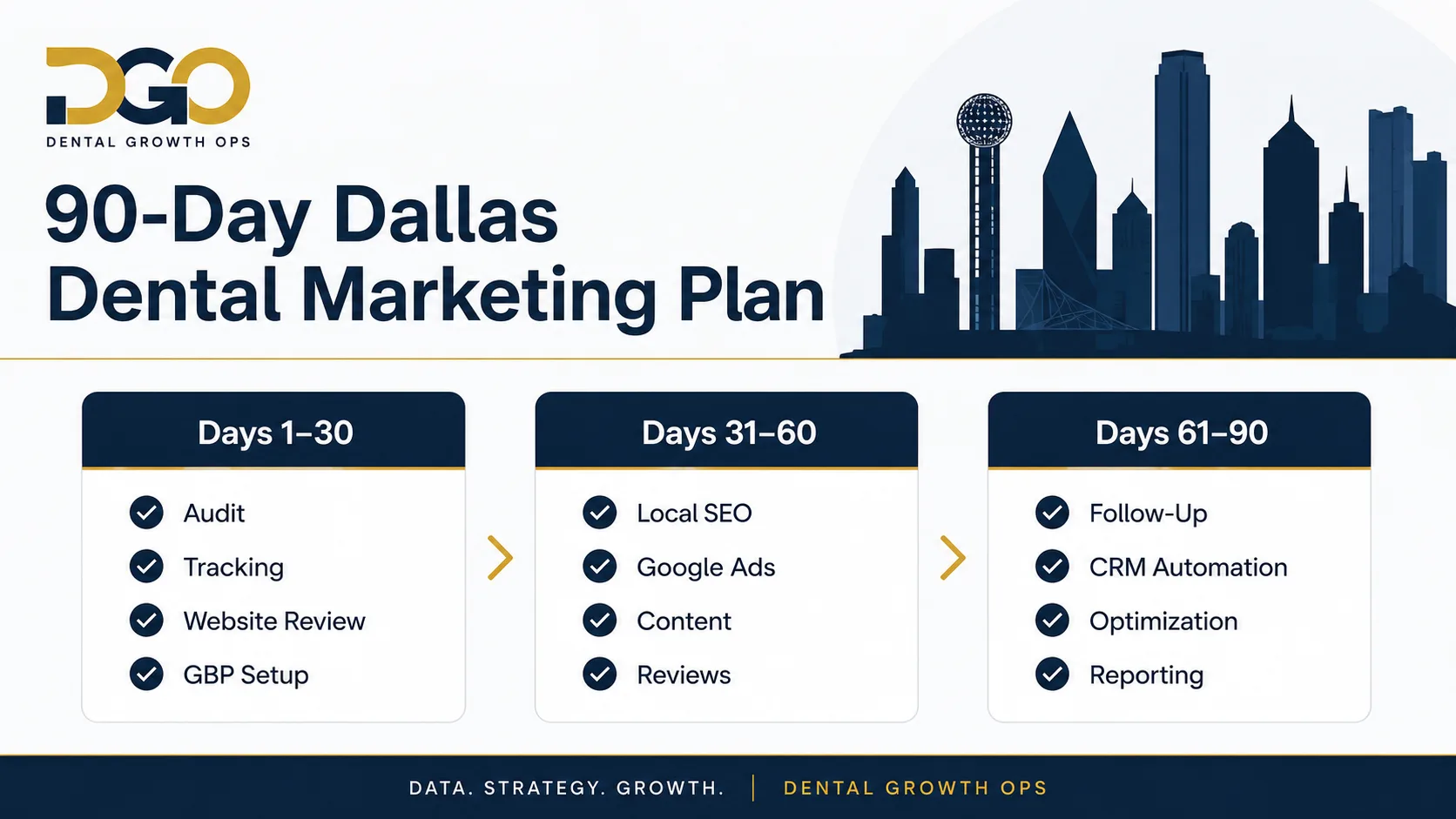
90-day Dallas plan at a glance
- Days 1 to 30Foundation, tracking and profile
- Days 31 to 60Acquisition and visibility
- Days 61 to 90Conversion and reallocation
Days 1 to 30: foundation
- Audit every current channel and record what each costs and produces today
- Define the catchment properly: drive time by treatment, not city limits
- Install tracking. Call tracking numbers, form source capture, UTMs, GA4 conversion events
- Review the website conversion path on a phone, on mobile data, as a patient would
- Complete the Google Business Profile and fix any name, address or phone inconsistency
- Set up the CRM: pipeline stages, lead sources connected, and a named owner for the pipeline
- Turn on the review workflow, including who asks and when
- Run the competitor evaluation above and record the local standard
- Write down baseline numbers for every metric in the table above
Days 31 to 60: acquisition
- Improve or rebuild the priority treatment pages, one per treatment, written for patients
- Begin the local SEO work: internal links, location relevance, technical fixes, citation accuracy
- Launch paid search by treatment, with matching landing pages and a negative keyword list
- Start retargeting for visitors who reached a treatment page and did not convert
- Publish the first clinician-informed content pieces
- Keep the review process running weekly, not in bursts
- Confirm every lead source flows into the CRM with its source intact
Days 61 to 90: conversion
- Analyse lead quality by source, not just lead volume
- Test landing page changes on the highest-spend campaign, one change at a time
- Measure and improve speed to lead using real contact-rate data
- Add nurture sequences now that the pipeline has enough volume to segment
- Turn on missed-call text-back and no-show recovery
- Run the first reactivation campaign to a defined segment
- Build the monthly report: booked patients, show rate, cost per booked patient by source
- Reallocate budget based on what the report shows, not on what was assumed in month one
Be explicit about what this window proves. Paid search, retargeting and reactivation give a readable answer inside 90 days. Local SEO, content and reputation typically do not, and judging them on this timeline is how practices abandon the work that would have produced the most durable results. This plan is an implementation framework, not a ranking guarantee, and nobody can responsibly promise a ranking position or a number of new patients in any market, least of all this one.
SEO Versus Google Ads for Dallas Dentists
This is the most common question we get from Dallas practice owners, and the answer is usually "both, in this order, for these reasons". The table below compares what each channel is for rather than quoting performance figures, because any figure would depend on your catchment, treatment mix and execution.
| Channel | Best for | Speed | Long-term value | Main limitation |
|---|---|---|---|---|
| Local SEO and Maps | Capturing existing demand near the practice | Slow | Compounding | Proximity limits reach, and results take quarters not weeks |
| Google Ads | High-intent treatment searches, immediate volume | Fast | Short-term | Visibility stops the day the budget stops |
| Meta Ads | Cosmetic and elective awareness, retargeting | Fast | Short-term | Lower intent, so follow-up quality decides the outcome |
| Website and CRO | Multiplying every other channel | Moderate | Compounding | Needs traffic before changes can be evaluated |
| Reputation and reviews | Map visibility and choice at the point of decision | Moderate | Compounding | Depends on the patient experience, which marketing cannot fix |
| CRM automation | Converting and retaining demand already paid for | Fast | Compounding | Needs a named owner and existing enquiry volume to work on |
The practical sequence for most Dallas practices: fix tracking and the website first, because they affect everything. Complete the Google Business Profile and start reviews immediately, because they are cheap and compounding. Run Google Ads if there is open capacity and budget, because it is the only source of enquiries in week one. Build local SEO in parallel, knowing it pays later. Put the CRM in place before, not after, the volume arrives.
Common Dallas Dental Marketing Mistakes
These are the patterns we see most often when we audit an existing programme, roughly in order of what they cost:
- Running ads to a generic homepage. The patient searched for implants and now has to go looking. The single most expensive mistake in dental paid search.
- No call tracking. Most dental enquiries are phone calls. Without tracking, the largest part of the result is invisible and budget decisions become guesses.
- Ignoring Google Maps. Investing in a website while the profile sits incomplete inverts the actual order of patient behaviour.
- A weak review process. Asking occasionally, when someone remembers, produces exactly the pattern that does not compound.
- Slow lead response. Every hour of delay competes against practices that replied already.
- No CRM. Enquiries scattered across an inbox, a notepad, a phone system and a lead platform cannot be measured or followed up consistently.
- Measuring clicks instead of appointments. The two frequently move in opposite directions.
- Generic city pages and duplicate location content. Building "dentist in [suburb]" pages with swapped city names is a liability across the whole site, not just those pages.
- No treatment-specific landing pages. Every channel converts worse without them, and paid search converts much worse.
- No follow-up after a form submission. An auto-reply is not follow-up.
- Targeting the whole metroplex. Geotargeting all of Dallas-Fort Worth for routine treatment funds clicks from patients who will never drive to you.
- Depending on one channel. A single algorithm change or a better-funded competitor becomes an existential problem.
When Should a Dallas Dentist Hire a Marketing Agency?
The honest answer depends far more on operational readiness than on budget size, and it cuts both ways.
Good fit
- Several channels running at once, with nobody internally owning them
- Meaningful monthly media spend, where mistakes are expensive
- Weak or absent attribution, so budget decisions are currently guesses
- Inconsistent lead follow-up that the front desk cannot fix while also running the front desk
- Competitive treatments such as implants, aligners or cosmetic work in a dense corridor
- Limited internal marketing capacity or expertise
- Multiple locations needing consistent processes and comparable reporting
- A need for CRM automation integrated with the practice management system
Not ready yet
- No chair capacity to see more patients. Marketing into a full schedule creates frustration, not growth
- Nobody assigned to answer and follow up enquiries
- No decision about which treatments matter most
- A budget that cannot fund a single channel past its minimum viable spend
- Unwillingness to share account access or to measure outcomes honestly
If you do engage an agency, insist on three things: you own your ad accounts, analytics and CRM data; media spend and management fees appear as separate line items; and reporting goes down to booked and attended patients rather than stopping at traffic. Any agency that resists those three is telling you something useful. You can see how we structure engagements on our dental marketing pricing page, what we cover across our services, and the work we publish in our case studies.
Why Dental Growth Ops
We are a dental-only marketing team, not a generalist agency with a dental page. We work with dental practices looking to build measurable patient acquisition and follow-up systems, connecting the website, local SEO, Google Ads, Meta Ads, CRM, email and SMS automation, reviews, lead follow-up and reporting into one system rather than a set of separate invoices.
The positioning is simple: Dental Growth Ops helps dental practices connect patient acquisition with the systems required to turn enquiries into booked opportunities. Most agencies stop at the first half. The second half is where the recoverable money usually sits.
What we do not do: promise rankings, guarantee a number of new patients, or quote a cost per patient before we have seen your catchment, your capacity and your current numbers. Anyone doing that is selling certainty they do not have. You can read more about how we work, or start with our dental marketing strategies guide if you want the channel-by-channel version before speaking to anyone.
Putting a Dallas Dental Marketing Plan Together
Dental marketing in Dallas rewards precision over volume. The practices that grow are not the ones spending the most. They are the ones that define their real catchment, pick the treatments worth competing for, build pages that answer the patient's actual question, respond faster than the practice down the road, and measure the whole chain through to treatment accepted.
Start where you are losing the most, which is rarely where it feels most urgent. If enquiries are low, the problem is in Attract or Convert. If enquiries are fine and production is flat, the problem is in Follow Up, Book or Retain, and no amount of additional ad spend will fix it. Get tracking in place before increasing budget, review it every 30 days, and change one thing at a time.
If you would like a second opinion on which stage is costing your practice the most, get in touch and we will walk through your channels, your follow-up and your numbers with you.
Moaz Arshad
Founder of Dental Growth Ops. Dental-only marketing specialist focused on new patient acquisition, local SEO, and paid media for dental clinics in the US and Canada.
More about us →